Rankings
Ranked by entry cost
Item 7 totals, cheapest low estimate first. The high end is the planning number. One brand in the directory has no Item 7 in the files behind this table.
Compiled from public filings and operator sites
Item 7 is the franchisor’s estimate of the initial investment needed to establish one outlet. It is a range assembled by the franchisor, not a bid and not a cap. The total may combine the franchise fee, deposits, construction, equipment, signage, opening inventory, training travel, professional costs and an assumption for additional funds. The FTC’s franchise guide advises buyers to compare those assumptions with their own costs and financing, not merely accept the cover-page total.
This table sorts by the low end because that is the conventional directory view. The high end remains visible because it is usually the more useful stress-test. Range width matters: a narrow estimate and a range spanning several hundred thousand dollars do not offer the same planning certainty.
The order
Shah’s Halal Food, FDD issued 10 April 2024: $197,000–$405,000 for a 1,200–2,000-square-foot restaurant. The fifteen high-column line items sum to $410,000 against a printed total of $405,000; this directory keeps the filing’s printed total and reports the gap. Crave Hot Dogs and BBQ, May 2024 comparative study: $301,500–$1,192,500, a wide band that the operator’s public materials associate with more than one physical format. Mad for Chicken, FDD issued 12 March 2025: $321,125–$691,700 for the full 2,000–4,000-square-foot restaurant, with a separate express range of $243,500–$470,700 and a three-outlet development agreement at $263,500–$711,700, neither of which is the sorted row. Doner Shack, FDD issued 29 April 2025: $498,000–$1,007,000 for 1,200–1,800 square feet, with a three-restaurant development agreement disclosed separately at $578,000–$1,087,000. 375° Chicken ‘n Fries, FDD issued 30 April 2024: $324,100–$521,500 for 800–1,500 square feet.
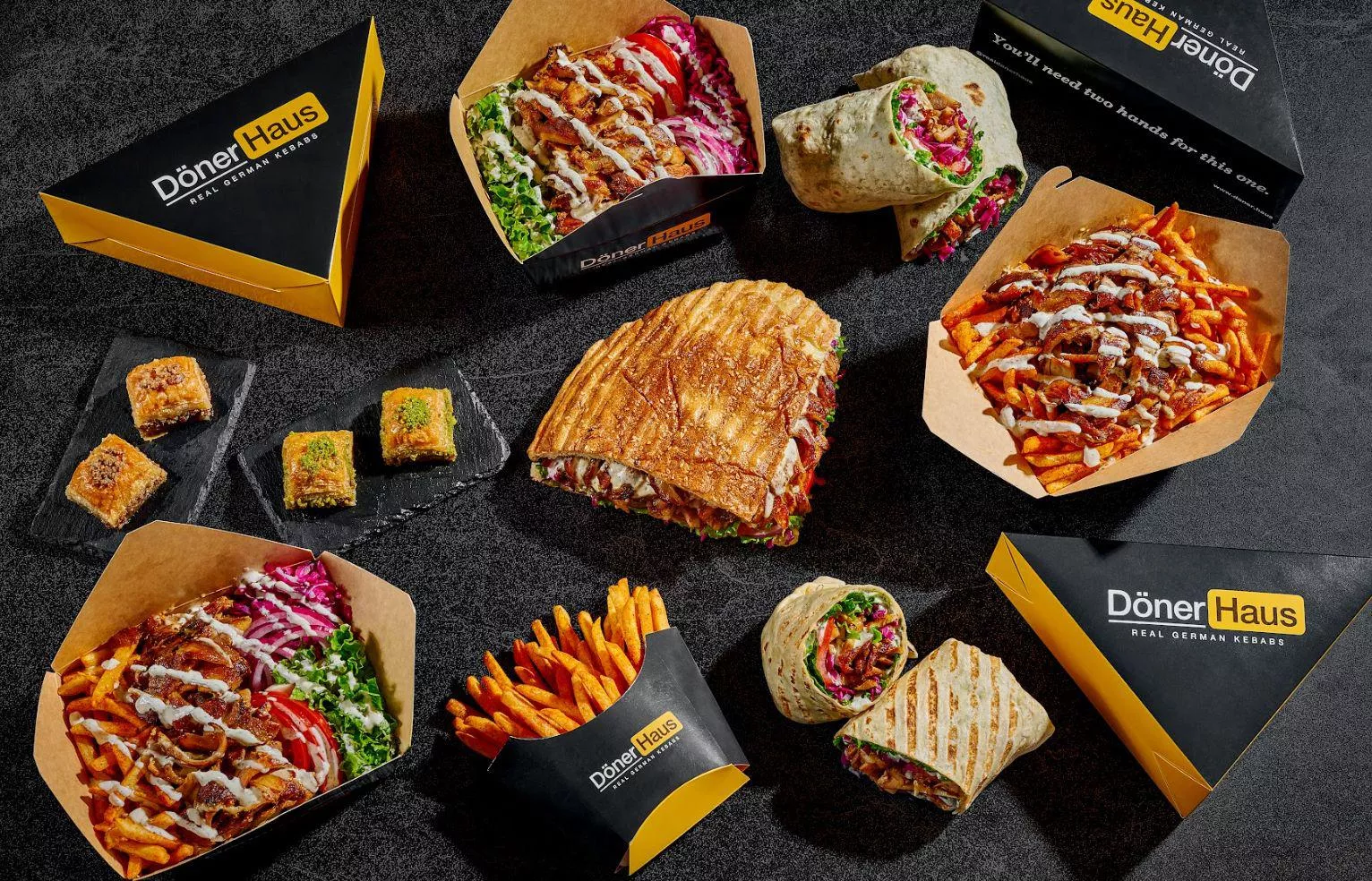
Dog Haus, May 2024 study: $357,437–$625,800. Döner Haus, 2026 Franchise Disclosure Document: $359,500–$586,000 for an 850–1,200-square-foot imbiss. Capriotti’s, May 2024 study: $417,100–$748,500. The Halal Guys, same study: $461,400–$1,333,500, with no typical square footage disclosed. The Great Greek, FDD issued 17 August 2023: $582,014–$1,088,560 for 1,800–2,000 square feet; the low end uses a discounted franchise fee available only to owners of affiliated brands, while a first-time buyer pays $39,500. Pepper Lunch, May 2024 study: $609,200–$1,471,500, the highest upper estimate in the directory. German Doner Kebab, FDD issued 3 September 2024: $690,500–$1,123,000 per outlet inside a five-outlet minimum commitment.
The totals do not share one scope
A compact counter-service shop, a food-court unit and a 2,000-square-foot dining room can all appear under “restaurant franchise” while requiring very different work. One filing may assume a second-generation restaurant; another may include a shell build. Some bundle fixtures and equipment into a package, while others separate mechanical, electrical and plumbing work from leasehold improvements. A zero-dollar low estimate on one construction line does not mean construction is free; another line or landlord assumption may carry it.
GDK’s Item 7 is the exhibit. The 2024 filing’s format note is a single outlet of 1,200–1,400 square feet inside a five-outlet minimum. Leasehold improvements run $0–$250,000; mechanical, electrical and plumbing run $150,000–$175,000; fit-out materials run $175,000–$205,000; restaurant equipment $140,000–$175,000. The $0 low on leasehold improvements is not a free restaurant. Shah’s construction line is $80,000–$160,000 with a much lower total. Great Greek’s leasehold improvements are $250,000–$650,000 plus a restaurant package of $225,964–$248,560. The Buildout Index shows how those public line items are grouped and why two printed totals can hide different bundles.
Square footage appears only where the source record states it. It helps explain the spread but still does not normalize the rows. Local labor, code upgrades, utility capacity, landlord contributions and the condition of the selected space remain site-specific.
The filing year is another scope boundary. These are nominal dollars from the year shown on each row; they are not inflation-adjusted into a common year. Comparing a 2023 construction estimate with a 2026 estimate is not the same as collecting two bids today.
Gaps stay visible
Wienerschnitzel has no Item 7 total in the source files behind this directory, so it is absent here while remaining in rankings supported by other fields. Filling that gap from an undated portal would create false precision. The brand is still the 323-unit, 1961 drive-through benchmark on system size and age, with a 6% stack, a 20-year term and no sale right.
bluTaco’s record states no initial franchise fee. That is a disclosed feature of that offering, not permission to infer that every missing percentage is zero. The brand remains unranked on the ongoing fee table because the source does not provide the royalty and brand-fund inputs required by that metric. It also has no Item 7 total in the files, so it is absent here as well.
Before relying on a printed range
- The total belongs to a format: full restaurant, express, imbiss, truck, ghost kitchen or host location.
- Every Item 7 line and footnote in the current FDD sits under that total.
- The high end is the stress-test. The low end is a directory sort, not a quote.
- Eligibility footnotes change the number, as with Great Greek’s affiliated-owner discount.
- A brand missing from this table has no total in the source files. A portal summary is not a substitute.
Use this page to identify differences worth investigating. Lowest published entry cost is a sorting rule, not a forecast of the final cheque. After the sort, read footprint for the seven sized brands, then the matching category essay so a $320,000 chicken express is not compared with a $320,000 full dining room as if they were one project.
Range width is its own screen. Shah’s band is about $208,000 wide. 375° is about $197,000 wide. Döner Haus is about $226,500 wide. Dog Haus is about $268,000 wide. Mad for Chicken’s full restaurant is about $370,500 wide. Doner Shack is about $509,000 wide. Capriotti’s is about $331,000 wide. Great Greek is about $506,000 wide. GDK is about $432,500 wide. Halal Guys is about $872,000 wide. Crave is about $891,000 wide. Pepper Lunch is about $862,000 wide. A narrow range can still be wrong for a given city; a range that spans most of a million dollars is a format-or-assumption question before it is a budget.
Franchise fees in the same rows do not sort with the totals. Shah’s and GDK both list $30,000. Döner Haus $35,000. Mad for Chicken $35,000. Dog Haus, Capriotti’s and 375° $40,000. Crave $45,000. Pepper Lunch $50,000. Halal Guys $60,000. Great Greek $39,500 for a first-time buyer. bluTaco none. Wienerschnitzel $32,000 with no Item 7 total attached. The fee is Item 5; the project is Item 7. Confusing them is how a $30,000 GDK fee becomes a one-shop daydream against a five-outlet minimum.
The how to use this directory says to underwrite the high end, then read the current FDD footnotes. This ranking is the sort that starts that conversation. It is a sort, not a contractor’s quote.
Mad for Chicken’s express range of $243,500–$470,700 is disclosed and still not the sorted row, because the ranked Item 7 is the full restaurant. Sorting on the express low end would mix formats inside one brand, which is the same error as mixing Döner Haus’s imbiss with GDK’s restaurant. Crave’s $301,500–$1,192,500 band is the other warning: restaurant, express and truck are not one project. The sort is the low end of the row this directory actually stores. The footnotes decide whether that row is the offer on the table.
Pepper Lunch’s $1,471,500 high end is the ceiling on this table. Shah’s $197,000 low end is the floor among printed totals. Most of the directory lives between those numbers without sharing a cuisine. Capital screens across aisles; category essays screen inside them. Use both.
Döner Haus’s 2026 range of $359,500–$586,000 sits near Dog Haus’s $357,437–$625,800 and 375°’s $324,100–$521,500. Those three low ends are neighbors on this sort and not neighbors on food, age or Item 19 sample. Proximity on Item 7 low is a capital screen, not a peer group.
| Brand | Total investment | Franchise fee | Typical size | Filed |
|---|---|---|---|---|
| Shah's Halal Food | $197,000–$405,000 | $30,000 | 1,200–2,000 sq ft | 2024 |
| Atomic Wings | $222,220–$860,773 | $25,000 | 1,200–1,800 sq ft | 2025 |
| Crave Hot Dogs and BBQ | $301,500–$1,192,500 | $45,000 | — | 2024 |
| Mad for Chicken | $321,125–$691,700 | $35,000 | 2,000–4,000 sq ft | 2025 |
| 375° Chicken 'n Fries | $324,100–$521,500 | $40,000 | 800–1,500 sq ft | 2024 |
| Dog Haus | $357,437–$625,800 | $40,000 | — | 2024 |
| Döner Haus | $359,500–$586,000 | $35,000 | 850–1,200 sq ft | 2026 |
| Capriotti's | $417,100–$748,500 | $40,000 | — | 2024 |
| The Halal Guys | $461,400–$1,333,500 | $60,000 | — | 2024 |
| Doner Shack | $498,000–$1,007,000 | $40,000 | 1,200–1,800 sq ft | 2025 |
| The Great Greek Mediterranean Grill | $582,014–$1,088,560 | $39,500 | 1,800–2,000 sq ft | 2023 |
| Pepper Lunch | $609,200–$1,471,500 | $50,000 | — | 2024 |
| German Doner Kebab | $690,500–$1,123,000 | $30,000 | 1,200–1,400 sq ft | 2024 |