Rankings
Ranked by term
Initial agreement length where the filing states a term in years, shortest first. Renewal and territory stay in the source's own words.
Compiled from public filings and operator sites
The initial term is how long the franchise agreement runs before renewal, expiration or whatever exit the contract actually provides. Most restaurant filings in this directory use ten years. Two do not: Wienerschnitzel at 20 years and The Great Greek Mediterranean Grill at 35. Brands without a stated term in years are omitted from the generated table rather than assigned a default.
bluTaco’s May 2024 comparative-study row has no fixed term: the agreement runs until either party terminates it. That indefinite structure is a fact about the offering, and it is why bluTaco cannot be sorted among 10-, 20- and 35-year rows.
Term length is a duration, not a quality score. A longer grant can reduce the number of renewal events; it also makes default, remodel, transfer and dispute clauses more important, because the parties may be bound for decades. A shorter grant with a clean renewal option can be easier to exit or refinance — if the renewal exists. Wienerschnitzel’s 20-year term in the May 2024 study comes with no right of renewal and no right to sell the business, a combination no other row in this directory shares.
Ten years is the default, not the whole deal
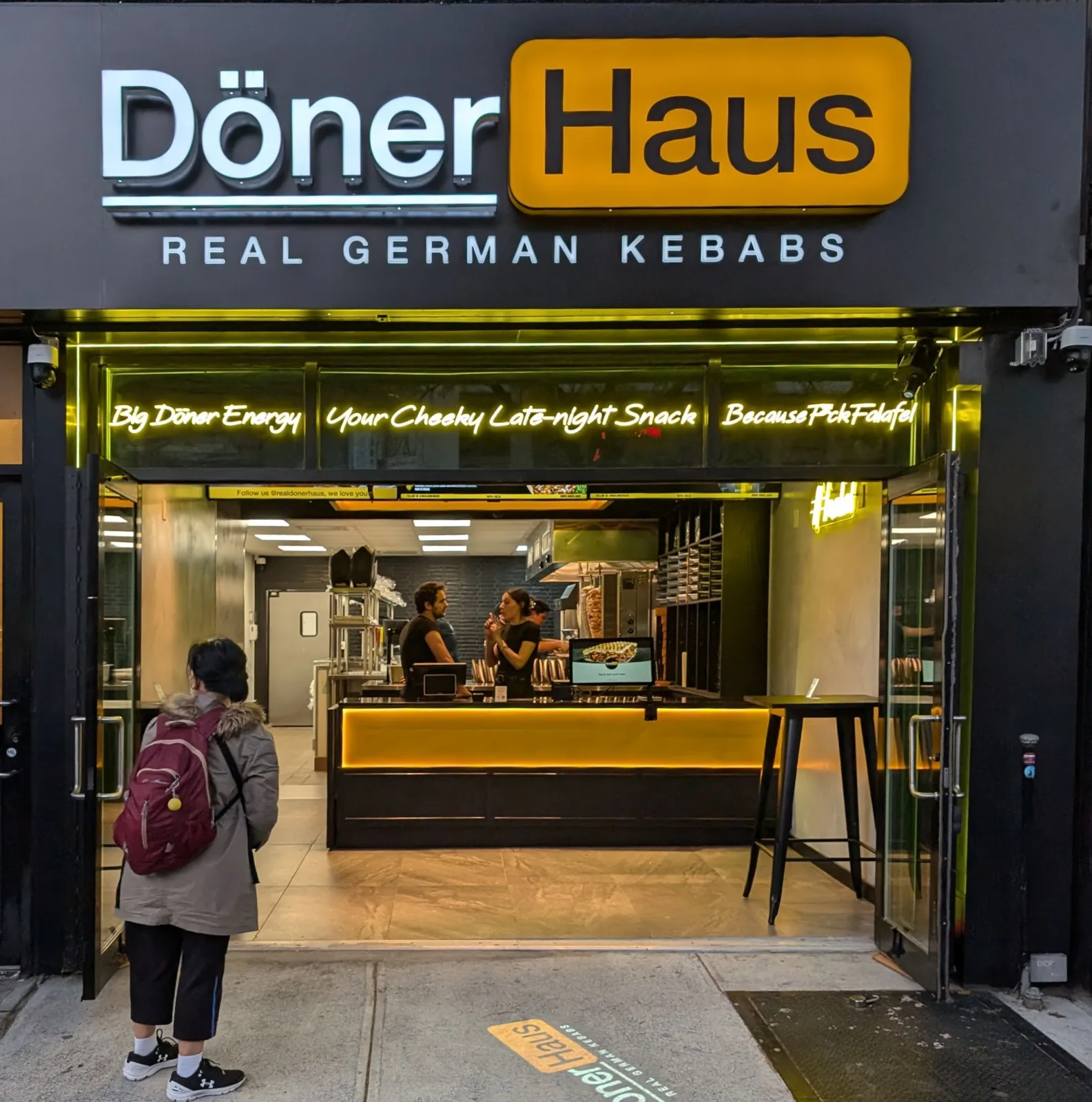
The ten-year group, from the filings on each row, includes German Doner Kebab, The Halal Guys, Shah’s Halal Food, Dog Haus, Crave Hot Dogs and BBQ, Pepper Lunch, Capriotti’s, Mad for Chicken, 375° Chicken ‘n Fries, Döner Haus and Doner Shack. Their renewal language is not uniform.
German Doner Kebab’s FDD issued 3 September 2024 offers one ten-year option, conditioned in part on the outlet not ranking in the bottom 10% on performance. Halal Guys, from the May 2024 study, offers one ten-year option. Shah’s 10 April 2024 FDD offers one additional ten-year term. Dog Haus offers successive ten-year terms. Crave, Pepper Lunch and Capriotti’s each offer one ten-year option in the study. Mad for Chicken’s 12 March 2025 FDD offers two successor terms of ten years each. 375°’s 30 April 2024 FDD offers two additional terms of ten years each. Döner Haus’s 2026 filing offers one ten-year successor term, at a $5,000 renewal fee. Doner Shack’s 29 April 2025 FDD offers two successive five-year terms rather than a second decade, so ten years of trading is followed by two shorter renewals subject to a default record test — the same twenty-year horizon as several rows above it, reached in three steps instead of two.
Those options are not automatic. Fees, remodel obligations, notice windows and default history sit in Item 17 and the agreement. The table prints the renewal phrase from the brand record; it does not reprint the full clause. The field guide’s term and territory chapter is the place to see why a one-line renewal summary is only a pointer.
Transfer fees in the same records also differ. Halal Guys lists $10,000. Crave lists $5,000. Dog Haus lists $17,500. Capriotti’s uses the greater of $10,000 or 5%, capped at $20,000. GDK, Shah’s, Pepper Lunch and 375° use a percentage of the then-current franchise fee — 50% in those rows. Great Greek uses the greater of $29,500 or 10% of the sale price, capped at the then-current franchise fee. Döner Haus uses 75% of the then-current initial franchise fee, the highest percentage of a fee in the directory, and Doner Shack lists a flat $10,000. bluTaco lists $2,500. A ten-year term with an expensive transfer is a different asset from a ten-year term that can be sold on a flat fee.
After the term column
- Renewal may be a right, an option, successive terms, or absent.
- GDK’s bottom-decile condition is a performance screen on the option.
- A long term on a non-exclusive site is not a protected market.
- Transfer and renewal fees belong to the exit, not to the opening-day romance.
- A blank term may mean an indefinite agreement, or it may mean the field is simply not on file.
Thirty-five years and twenty years
The Great Greek’s FDD issued 17 August 2023 discloses a 35-year initial term and one additional 35-year term, against ten years almost everywhere else in the directory. The 2023 row records 31 outlets, 1,800–2,000 square feet and a 10% fee stack. A 35-year grant on a fast-casual grill is a planning horizon that outlasts most equipment cycles and many lease structures. It does not by itself make the offering safer; it makes the transfer, default and remodel provisions the documents a lender and a lawyer will actually underwrite.
Wienerschnitzel, from the May 2024 study, discloses a 20-year term, 323 outlets and no protected area. The study also records no right of renewal and no right to sell the business. Age and scale therefore sit beside unusually strict exit terms. Someone who assumes they can assign the restaurant or extend after year 20 is not reading this row. The Dog Haus versus Wienerschnitzel compare exists because both sell hot dogs and almost nothing in the filings is interchangeable.
Territory is the other half of the term
A term without a useful territory grant is a license to operate at a point, not a market. Capriotti’s and Wienerschnitzel disclose no protected area. German Doner Kebab’s territory is non-exclusive, with no minimum size, negotiated from demographics, and excludes campuses, sports venues, transport sites and aggregator delivery zones. 375°’s territory is a specific location rather than an area, sized case by case, and is not exclusive. Mad for Chicken is also non-exclusive: a minimum five-mile radius in the suburbs or a quarter-mile in a city, sized after the site is approved. Doner Shack’s grant is protected but expressly not exclusive, with no minimum geographic size and boundaries drawn case by case from the target demographic and described by zip codes, streets or landmarks. Döner Haus’s is limited protection rather than exclusivity, sized at about 50,000 population, or a one-mile radius where fewer than that live and work within it.
Halal Guys ranges from a quarter-mile to two miles by area. Shah’s extends up to five miles by driving distance and shrinks in cities; non-traditional sites are excluded. Dog Haus ranges from a half-mile to five miles, set from demographics, population, income and age. Crave states a five-mile radius. Great Greek is typically a one-mile radius, smaller in dense areas, not exclusive, with limited-access venues excluded. Pepper Lunch is set from demographics and population density. bluTaco is a one-mile radius or less, set by population.
Those phrases are the filings’ territory language, not a survey of every carve-out in every agreement. A ten-year term on a quarter-mile, non-exclusive site is a different economic object from a 35-year term on a one-mile radius that is still not exclusive. The generated table keeps term, renewal and territory on one row so that mismatch is visible.
Indefinite, missing and not comparable
bluTaco belongs in this discussion and not in the sorted table. No initial franchise fee, no required local advertising, no grand opening, no ranked royalty, 11.5 on-the-job training hours, and an agreement that continues until termination. Sorting that offering as “zero years” would be as misleading as sorting a missing royalty as a zero-percent stack.
Use this ranking to see who is offering a decade, a generation or an open-ended contract. Then read the Item 19 split and the fee table before treating duration as value.
The generated table sorts shortest stated term first, so the ten-year majority will occupy most of the rows, Wienerschnitzel 20, Great Greek 35. bluTaco will not appear. A printed “10 yrs” is still five different renewals in this directory: successive terms, one option, two extra ten-year terms, two five-year terms, and GDK’s performance-conditioned option. Read the renewal cell on the same line as the term cell.
Territory language in the third column is the other mismatch. “No protected area” at Capriotti’s and Wienerschnitzel is not the same as 375°’s specific location or GDK’s non-exclusive grant with venue and delivery carve-outs. A 35-year Great Greek term on a typically one-mile, non-exclusive radius is a long relationship to a point in space, not a 35-year monopoly. A 20-year Wienerschnitzel term with no sale right is a long relationship the owner may not be able to assign.
This page ranks disclosed term. It does not rank how easy the relationship is to leave.
GDK’s ten-year option is the performance-conditioned row: not in the bottom 10%. Mad for Chicken and 375° each offer two extra ten-year terms, which is not the same as Great Greek’s additional 35-year term and not the same as Dog Haus’s successive ten-year terms. “Has renewal” is not a boolean that survives contact with Item 17. Read the phrase on the row, then the clause in the agreement. Duration without exit is not equity.
| Brand | Term | Renewal | Territory |
|---|---|---|---|
| Döner Haus | 10 yrs | One ten-year successor term | Limited protection, not exclusive; about 50,000 population, or a one-mile radius where fewer than that live and work within it |
| Pepper Lunch | 10 yrs | One ten-year option | Set from demographics and population density |
| Shah's Halal Food | 10 yrs | One additional ten-year term | Up to five miles by driving distance, smaller in cities. Non-traditional sites are excluded. |
| 375° Chicken 'n Fries | 10 yrs | Two additional terms of ten years each | A specific location rather than an area, sized case by case. Not exclusive. |
| Dog Haus | 10 yrs | Successive ten-year terms | Half-mile to five-mile radius, set from demographics, population, income and age |
| Mad for Chicken | 10 yrs | Two successor terms of ten years each | Non-exclusive. Minimum five-mile radius in the suburbs, a quarter-mile in a city, sized after the site is approved. |
| The Halal Guys | 10 yrs | One ten-year option | Quarter-mile to two-mile radius, set by area |
| Capriotti's | 10 yrs | One ten-year option | No protected area |
| Crave Hot Dogs and BBQ | 10 yrs | One ten-year option | Five-mile radius |
| Doner Shack | 10 yrs | Two successive five-year terms, subject to a default record test | Protected but expressly not exclusive. No minimum geographic size; boundaries drawn case by case from the target demographic and described by zip codes, streets or landmarks. |
| German Doner Kebab | 10 yrs | One ten-year option, if the outlet is not in the bottom 10% on performance | A non-exclusive protected territory with no minimum size, negotiated from demographics. Excludes campuses, sports venues, transport sites and aggregator delivery zones. |
| Wienerschnitzel | 20 yrs | — | No protected area |
| The Great Greek Mediterranean Grill | 35 yrs | One additional thirty-five-year term | Typically a one-mile radius, smaller in dense areas. Not exclusive. Limited-access venues excluded. |