Rankings
Ranked by footprint
Typical disclosed square footage, smallest low-end first. Brands without a size on file are omitted rather than estimated.
Compiled from public filings and operator sites
Square footage is the planning number most likely to be skipped on a cover page and most likely to decide rent, construction and staffing. Item 7 totals mix franchise fees, deposits, equipment and working capital; they do not by themselves say whether the filing is describing a standing counter or a 2,000-square-foot dining room. This ranking uses the typical size stated in the brand record, sorted by the low end of that range.
Only live US offerings with a disclosed size appear. A blank is not treated as a small shop. The May 2024 comparative study behind several rows does not record square footage for The Halal Guys, Dog Haus, Crave Hot Dogs and BBQ, Pepper Lunch, Capriotti’s, Wienerschnitzel or bluTaco, so those brands are absent here even though they remain in other tables. Filling those gaps from a franchise portal or a later marketing page would invent a number this directory does not have.
The seven disclosed ranges
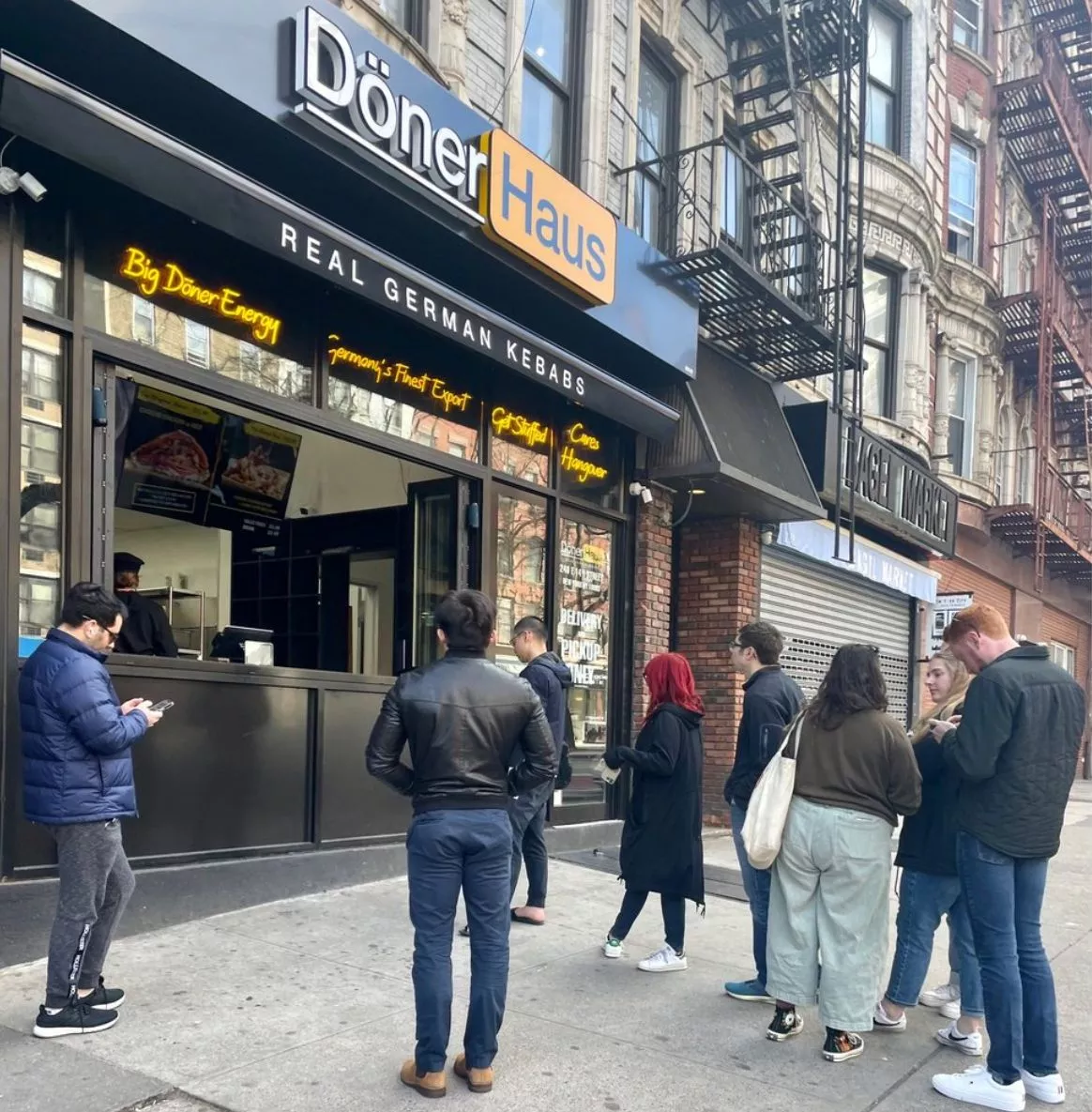
Döner Haus, from the 2026 Franchise Disclosure Document, is the compact end of the table: 850–1,200 square feet for a standing-service imbiss. 375° Chicken ‘n Fries, from the FDD issued 30 April 2024, discloses 800–1,500 square feet. German Doner Kebab’s FDD issued 3 September 2024 assumes 1,200–1,400 square feet — a restaurant, not a window, and one outlet inside a five-outlet minimum commitment.
Shah’s Halal Food, FDD issued 10 April 2024, discloses 1,200–2,000 square feet for a full-sized restaurant. The Great Greek Mediterranean Grill, FDD issued 17 August 2023, assumes 1,800–2,000 square feet for an in-line or end-cap grill. Mad for Chicken, FDD issued 12 March 2025, discloses 2,000–4,000 square feet for the full restaurant, with a separate express investment range that does not reuse this larger footprint. Doner Shack, FDD issued 29 April 2025, assumes 1,200–1,800 square feet, a band that overlaps three other sized rows and belongs to a system with no US outlets behind it.
Those seven rows already show why “QSR” is not a size. An 850-square-foot counter and a 4,000-square-foot fried-chicken dining room can both be quick service. They do not share a lease search, a hood package or a labor chart. The Buildout Index groups public Item 7 line items so two printed totals can be compared without pretending the premises are the same.
When a size is on the row
- The range belongs to a format: imbiss, mall counter, full restaurant, express or another variant.
- Item 7 footnotes carry second-generation assumptions, landlord work and equipment packages.
- A compact range does not describe a seated concept. An express total does not describe a dining room.
- Missing size is missing. Host-location and drive-through brands here often have no square-foot field.
- Rent and construction are local. The filing’s typical size is not a bid.
Size and capital do not move in lockstep
A smaller disclosed box can still be an expensive project. 375°’s 800–1,500-square-foot range carries an Item 7 of $324,100–$521,500 in the 2024 filing. Mad for Chicken’s much larger full restaurant is $321,125–$691,700 — overlapping at the low end despite a footprint that can be several times wider. Shah’s 1,200–2,000-square-foot restaurant prints $197,000–$405,000, the lowest Item 7 band among sized brands, while German Doner Kebab’s narrower 1,200–1,400-square-foot box sits at $690,500–$1,123,000 per outlet inside the multi-unit commitment.
Great Greek’s 1,800–2,000-square-foot grill is $582,014–$1,088,560, and the low end uses a discounted franchise fee available only to owners of affiliated brands. Döner Haus’s compact 2026 range is $359,500–$586,000. Those figures are nominal dollars from the year on each row; they are not inflation-adjusted into a common year.
Footprint explains some of the spread and none of the finish. Construction line items, working-capital months and whether the filing assumes a vanilla shell or a second-generation restaurant still have to be read in the current document. The entry-cost ranking sorts the totals; this page sorts the box.
What omitted brands tell you
bluTaco’s May 2024 study row records 34 outlets and no square-foot assumption. The operator’s locator includes stores inside host businesses, so treating those 34 as freestanding dining rooms would be a category error even if a size appeared. Wienerschnitzel is a drive-through hot-dog chain with 323 outlets in the same study and no Item 7 total in the files behind this directory; size is likewise absent. Halal Guys has 93 outlets and a wide Item 7 band of $461,400–$1,333,500 without a typical square-foot field in the source.
Pepper Lunch’s US row is six franchised units and an Item 7 of $609,200–$1,471,500, the highest upper estimate in the directory, still without a disclosed size here. Dog Haus and Crave are hot-dog systems whose public materials discuss restaurants, ghost kitchens, express units or trucks; the study row used for ranking does not attach a square-foot range to those variants. Capriotti’s 145-unit sandwich system is the same: investment is on file, typical size is not.
Absence on this table is therefore information. It means the source record used for the directory does not state a comparable footprint, not that the restaurants occupy no space.
How to read the sort
Smallest low-end first is a directory convention, not a recommendation to buy the tightest box. An 850-square-foot imbiss can be the right project for a walk-up street and the wrong project for a parking-field lunch trade. A 2,000-square-foot grill can support a broader menu and a longer dwell time while demanding more rent, more hood capacity and more people on the clock.
The training ranking is a useful next cut: larger dining rooms in this directory often, but not always, disclose more on-the-job hours. Wienerschnitzel’s 480 on-the-job hours sit on a brand with no size in the table; Great Greek’s 180 on-the-job hours sit on the 1,800–2,000-square-foot grill. Hours measure the disclosed training commitment, not the square footage.
For German döner specifically, footprint is the difference that decides whether two packets are peers. The German döner essay and the Döner Haus versus GDK compare exist so that 850–1,200 and 1,200–1,400 are not collapsed into one “kebab shop.”
The generated table will list only the seven sized brands. Anyone using this page as a screen should keep a second list of unsized live offerings that still compete for your site: Halal Guys, Dog Haus, Crave, Pepper Lunch, Capriotti’s, Wienerschnitzel and bluTaco. Those seven are not smaller than 850 square feet; they are undocumented on this field. Asking a broker to “just use 1,500” for them would invent a number.
Working-capital months, where the companion Item 7 tables records them, also fail to track size neatly. GDK, Shah’s, Mad for Chicken, 375° and Döner Haus show three months on the line-item filings; Great Greek shows up to six. That is a cash-timing difference inside the printed total, not a square-foot difference. The Buildout Index is where those line items are compared.
This page ranks disclosed size. It does not rank throughput, rent or fit.
An 850–1,200-square-foot imbiss can still fail a parking-field lunch trade, and a 2,000–4,000-square-foot fried-chicken room can still be the wrong rent for a walk-up street. The ranking does not know the site. It only knows which seven live offerings stated a typical size on file. For the other seven, ask the current FDD and the landlord’s plan. Do not borrow Döner Haus’s 850–1,200 or Great Greek’s 1,800–2,000 to complete a Halal Guys or Wienerschnitzel row. Those would be invented footprints.
375° at 800–1,500 square feet and Döner Haus at 850–1,200 are the compact pair. GDK at 1,200–1,400 and Shah’s at 1,200–2,000 overlap on paper and diverge on Item 7 ($690,500–$1,123,000 versus $197,000–$405,000) and on development structure. Size overlap is not cost overlap. Read both rankings.
Great Greek at 1,800–2,000 and Mad for Chicken at 2,000–4,000 are the large dining-room end. They still do not share a cuisine, a term (35 years versus 10) or an Item 19 sample. Footprint got them onto the same end of this table. The rest of the directory keeps them apart.
| Brand | Typical size | Investment | Units | Filed |
|---|---|---|---|---|
| 375° Chicken 'n Fries | 800–1,500 sq ft | $324,100–$521,500 | 5 | 2024 |
| Döner Haus | 850–1,200 sq ft | $359,500–$586,000 | 6 open | 2026 |
| Shah's Halal Food | 1,200–2,000 sq ft | $197,000–$405,000 | 58 | 2024 |
| Atomic Wings | 1,200–1,800 sq ft | $222,220–$860,773 | 20 | 2025 |
| Doner Shack | 1,200–1,800 sq ft | $498,000–$1,007,000 | 0 | 2025 |
| German Doner Kebab | 1,200–1,400 sq ft | $690,500–$1,123,000 | 5 open | 2024 |
| The Great Greek Mediterranean Grill | 1,800–2,000 sq ft | $582,014–$1,088,560 | 31 | 2023 |
| Mad for Chicken | 2,000–4,000 sq ft | $321,125–$691,700 | 12 | 2025 |