Reading the table
What the filings leave blank
Missing Item 7, an undisclosed royalty and term, absent Item 19, unstated footprints and exit terms — the blanks in these tables, and why they stay empty.
Compiled from public filings and operator sites
The em dash in these tables means the filing does not say. Do not fill it in from a franchise portal. A blank royalty is not 0%.
Portals reprint FDD summaries without identifying which filing year they are reprinting, so a number retrieved that way looks precise and cannot be dated — the worst combination available. A visible gap sends a reader to the current document. A confidently wrong figure does not. The methodology states the rule once: a blank is never estimated, never carried across from a similar brand, and never filled from a listing.
Item 7: two rows with no total, and six with no line items
Wienerschnitzel is the sharpest blank on the table. The May 2024 comparative study row records 323 outlets, a 1961 founding, franchising from 1965, a 5% royalty, a 1% brand fund, a 20-year term and 528 training hours — and no total investment range at all. It is the largest and oldest system in the directory and it is absent from the entry-cost ranking entirely, because there is nothing to sort it on. Age did not fill that cell and neither did scale.
bluTaco is the second, and its blank is part of a wider pattern discussed below. A missing Item 7 has a specific cost: there is no disclosed outer bound on what opening a unit requires, no way to size financing, and no way to compare the brand against the ranges that do exist — Shah’s $197,000–$405,000 at the cheap end of the table, or Pepper Lunch’s $609,200–$1,471,500 at the top. The current Item 7 table, with its footnotes, still assumes a format and a square footage. A contractor’s budget for the actual site is a different document, because Item 7 discloses a range, not a quote for a lease the franchisor has never seen.
The line-item detail behind Item 7 is thinner still. Individual cost rows exist for six filings: German Doner Kebab, Shah’s Halal Food, The Great Greek, Mad for Chicken, 375° Chicken ‘n Fries and Döner Haus. For every other brand there is at most a printed total, which says nothing about whether the range is dominated by leasehold improvements, by equipment, or by a thin working-capital assumption — and those assumptions differ sharply even among the six, from three months of additional funds at GDK, Shah’s, Mad for Chicken, 375° and Döner Haus to six months at Great Greek.
One of the six carries an arithmetic gap rather than a blank. Shah’s high column sums to $410,000 against a printed total of $405,000, and the filing repeats the printed total on its cover page. That discrepancy is stored and shown rather than quietly corrected, because correcting a document’s own arithmetic means publishing a number that appears nowhere in the filing.
The row with no royalty and no term
bluTaco’s May 2024 study row discloses 34 outlets, 33 franchised and one company-owned, founded 2017 and franchising since 2018, with a territory of a one-mile radius or less and a $2,500 transfer fee. It discloses no royalty rate, no brand fund and no fixed term; the agreement runs until either party terminates it. There is no Item 7, no Item 19, no grand-opening requirement, no initial franchise fee and no required local advertising spend.
Two of those absences are affirmative disclosures rather than gaps. The franchise fee reads “None” and the local advertising requirement is stated as not required. The royalty and the term are genuine blanks, and they are the two that make the row unscorable: without both a royalty and a fund the brand cannot appear in the fee ranking, and without a stated horizon it is omitted from by term. Entering zeros would place the least forthcoming filing at the top of a table about cost, which is the failure mode the ranking exists to avoid.
If no royalty is disclosed, the next fact to establish is what consideration the franchisor receives, and through what mechanism: supply, equipment, a fixed charge, something else. Termination rights on each side of an at-will agreement interact with a lease and with any loan. One-brand categories treats this filing at length; it is the least ready to be compared of anything on the table.
Local advertising: three blanks that are not zeros
Wienerschnitzel, Dog Haus and Pepper Lunch disclose no required local advertising percentage. Their stacks — 6%, 8% and 7% — are therefore built from a royalty and a fund only. If any of those three filings does require local spend under a heading the source row did not capture, the published stack understates the compulsory percentage by whatever that requirement is. Against the 1% to 2% the other rows disclose, that is not a rounding difference.
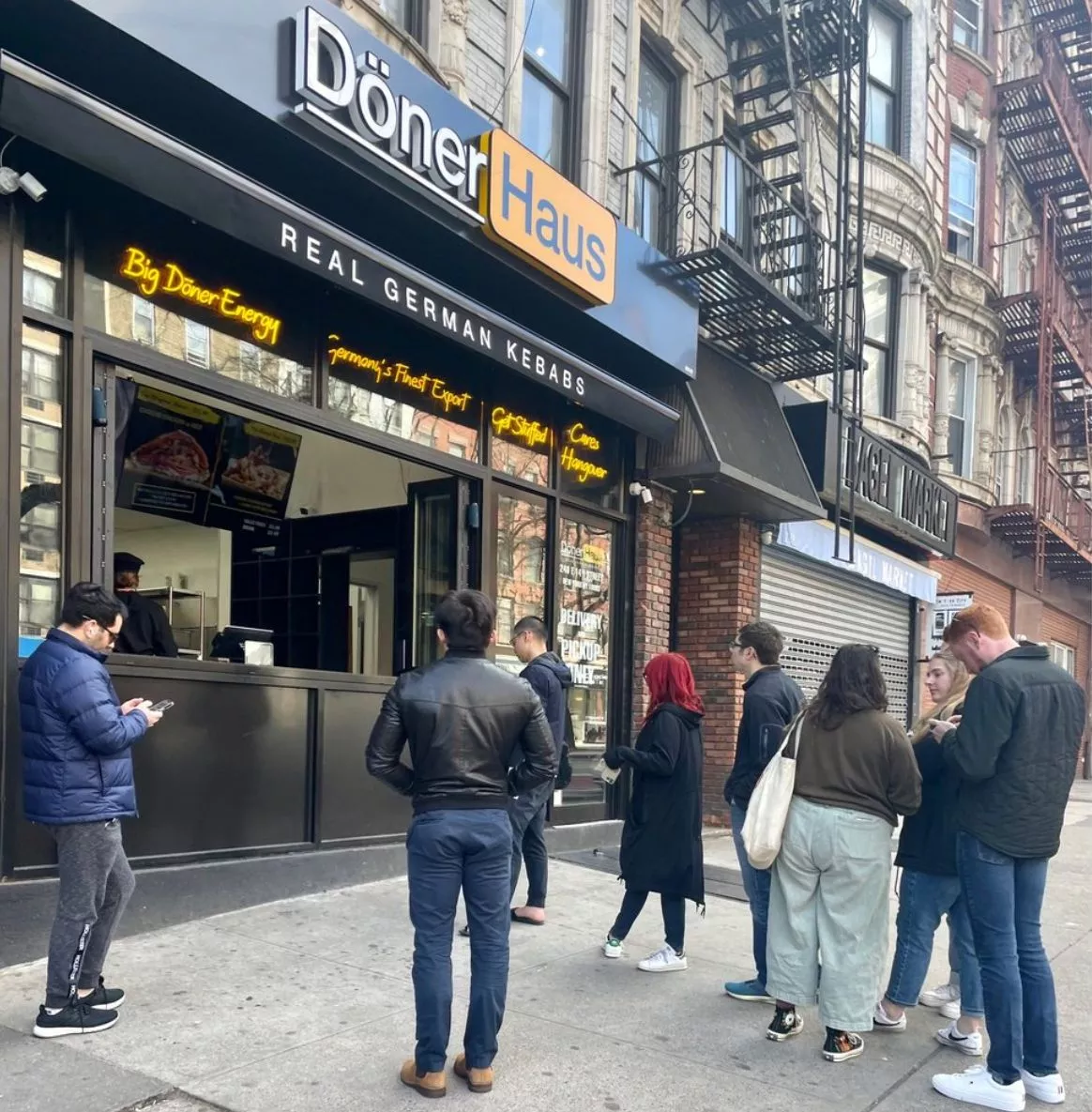
Döner Haus shows why the blank has to be read rather than counted. Its 5% stack also carries no local percentage, but not because nothing is required: the 2026 filing sets the obligation at a flat $2,000 a month, subject to a 10% annual increase. A dollar figure cannot join a percentage column, so the requirement is real and the stack still cannot show it.
Item 6 can impose a local or regional advertising obligation, a cooperative levy, or a minimum spend enforced through the operations manual rather than the fee schedule. The fee stack explains why a co-op levy standing in for a direct requirement is a change of payee rather than a saving.
Item 19: four absences, and four presences with no described sample
Five brands make no financial performance representation in the sources here: The Halal Guys, Shah’s Halal Food, Crave Hot Dogs and BBQ, bluTaco and Doner Shack. Doner Shack’s is the least surprising of the five: no Item 19 was located in its FDD issued 29 April 2025, and the same document’s Item 20 reports no US outlet at the start or end of 2022, 2023 or 2024, so there is no US operating record for a representation to describe. The Halal Guys is the row that unsettles people, because 93 outlets in the May 2024 study, 88 of them franchised, and a nationally recognised name produce no Item 19 at all. Shah’s 10 April 2024 filing states expressly that no financial performance representation is made. Absence is a disclosure choice, not a finding about the business. It means the model has to be built from franchisee interviews and trade-area work.
The subtler problem is on the other side. Nine brands are recorded as making a representation, but for four of them — Wienerschnitzel, Capriotti’s, Dog Haus and Pepper Lunch — there is no note describing what the representation covers. A “Yes” with no described population is a reason to read the current document, not a number. The descriptions that are on file show how much that matters: Great Greek’s 17 August 2023 filing reports on six affiliate restaurants plus the highest and lowest of six franchise restaurants open two years; Mad for Chicken’s 12 March 2025 filing covers affiliate and franchised outlets on revenue only, with no costs or profit, and excludes six outlets that closed during the year; 375°’s is an unaudited income statement for the affiliate that operates the restaurants; GDK’s rests on a single franchised outlet at the American Dream Mall, the only unit open for the full year. Those are four different evidentiary objects wearing one “Yes”.
This directory does not convert Item 19 into a projection. By Item 19 splits presence from absence and stops there, which is the only honest thing a table can do with a field whose contents are that heterogeneous.
Footprint: seven rows with no square footage
Seven brands disclose a size assumption: Döner Haus at 850–1,200 square feet in the 2026 document, 375° at 800–1,500, German Doner Kebab at 1,200–1,400, Shah’s at 1,200–2,000, Doner Shack at 1,200–1,800 in the FDD issued 29 April 2025, Great Greek at 1,800–2,000 and Mad for Chicken at 2,000–4,000. Seven disclose none — The Halal Guys, Dog Haus, Crave Hot Dogs and BBQ, Pepper Lunch, Capriotti’s, Wienerschnitzel and bluTaco — and are therefore absent from footprint.
A missing footprint breaks two things at once. It makes the Item 7 range uninterpretable, because a build cost without a size is a number without a denominator: Crave’s $301,500–$1,192,500 spans nearly nine hundred thousand dollars and the row does not say what sits at either end. And it makes site search guesswork. What the current filing has to supply is the target size range, the minimum viable bay, the seating assumption if any, and whether the disclosed investment covers an inline unit, an end cap, a freestanding building or a drive-through.
Exit terms, ownership splits and dates
Renewal and transfer terms are the least evenly disclosed group on the table. Shah’s, Mad for Chicken and 375° all disclose a renewal right without a renewal fee. Pepper Lunch discloses one as whatever the franchisor requires at renewal, which is a disclosure of indeterminacy rather than a blank. Wienerschnitzel’s row has neither because it grants neither: no right of renewal and no right to sell the business, which is a stated term rather than a gap and the most significant single field on that row.
Döner Haus’s transfer fee is the one worth reading twice, because it is complete rather than blank and still easy to misjudge: 75% of the then-current initial franchise fee, against a $5,000 renewal fee on a ten-year term with one ten-year successor term. A percentage of a fee that the franchisor sets at the time of sale is a charge whose size the seller does not know when signing.
Ownership splits are complete: all fourteen live rows state how many outlets are franchised and how many are company-owned, which is what makes franchised and company-owned possible as an analysis at all. Dates are patchier. 375° has no founding year on file, only a 2023 franchising start, and so it does not sort on by age at all rather than being aged from its franchise-program year. Shah’s has no franchising-start year. Those are small blanks with real consequences for any argument that turns on how long a system has been selling franchises as opposed to operating restaurants.
Why the blanks stay
Every gap above could be closed in an afternoon by copying from a franchise portal, and every one of them would then be undated, unattributable and occasionally two disclosure years stale. The table already spans 2023 to 2026; its discipline is that the year travels with the figure. A borrowed number destroys that invisibly, because a filled cell and a verified cell look identical in a table.
So the blanks stay. They are the worklist. The brands that generate the longest lists of missing fields are the ones that look cheapest when someone fills them in. How to use this directory puts that in reading order; the head-to-head index shows where two rows can be set side by side and where they cannot.