Reading the table
What an ongoing fee actually is
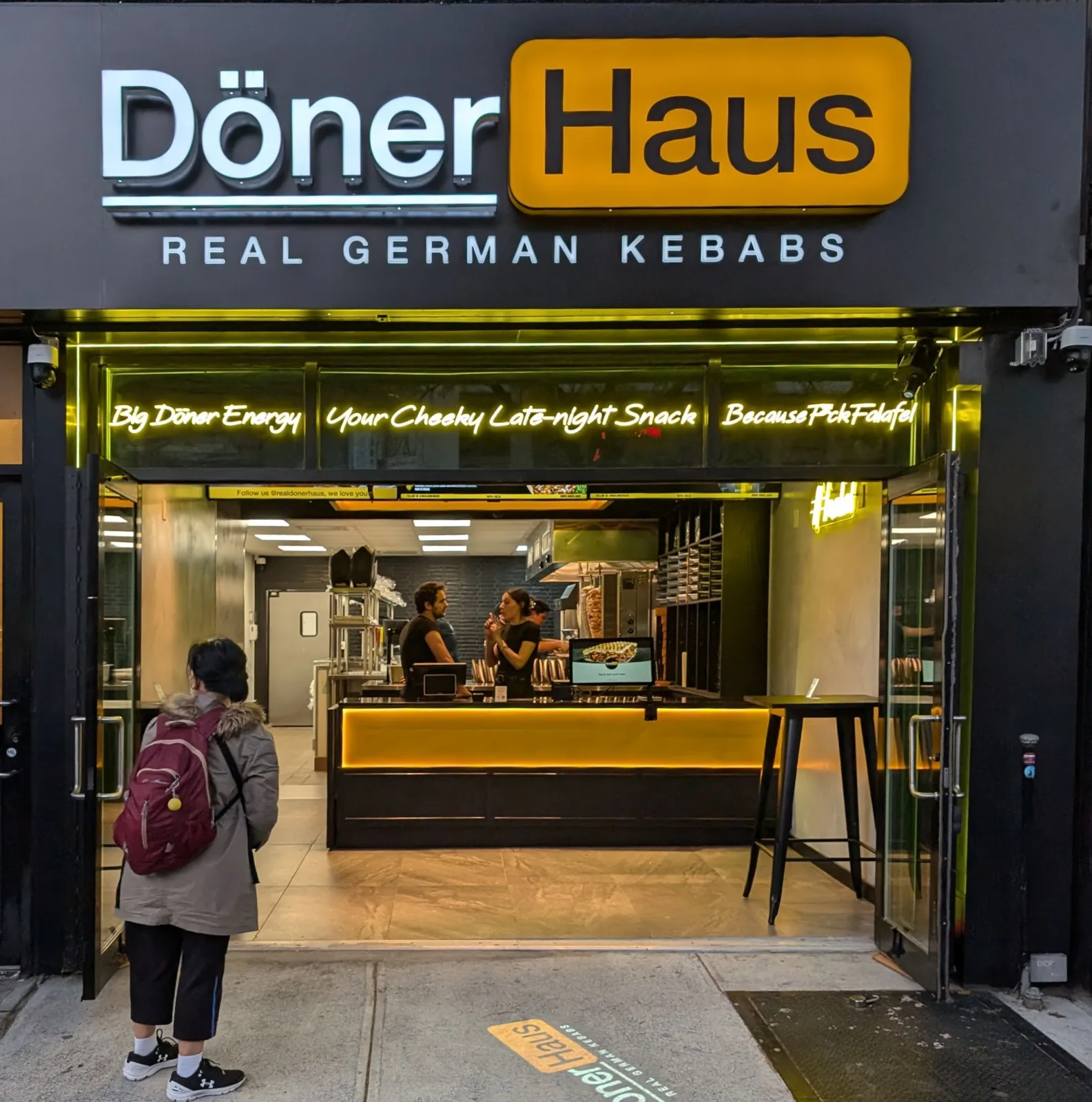
Royalty plus brand fund plus required local advertising. Döner Haus's 5% is what leaves the shop for the system; its $2,000 local spend stays in the operator's market.
Compiled from public filings and operator sites
“The royalty is six percent” survives in franchise conversation because it is short, and it fails in four separate ways on this table alone: when a brand fund sits beside the royalty; when the franchisee is separately required to spend on local advertising; when a percentage or a flat charge outside that group is compulsory anyway; and when the rate depends on which format the buyer is being sold.
The answer here is a fee stack: royalty, plus the national or brand advertising fund, plus any local advertising spend the franchisor can require. Three percentages of gross sales, all compulsory, listed on separate rows of Item 6 because that is how the disclosure form is built. Adding them is not a finding; it is arithmetic no filing performs for the reader. The point of this page is what the arithmetic still leaves out.
The three components, brand by brand
| Brand | Royalty | Brand fund | Local advertising | Stack | Source |
|---|---|---|---|---|---|
| Döner Haus | 3% | 2% | $2,000 a month, subject to a 10% annual increase | 5% | 2026 Franchise Disclosure Document |
| Wienerschnitzel | 5% | 1% | — | 6% | May 2024 comparative study |
| Pepper Lunch | 5% | 2% | — | 7% | May 2024 comparative study |
| Shah’s Halal Food | 5% | 1% | 1% | 7% | FDD issued 10 April 2024 |
| Dog Haus | 6%, or 4% for a ghost kitchen | 2% (may rise to 3.5%) | — | 8% | May 2024 comparative study |
| Mad for Chicken | 5% | 1% brand fund plus 1% media marketing | 1% | 8% | FDD issued 12 March 2025 |
| 375° Chicken ‘n Fries | 6% | 1% | 1% | 8% | FDD issued 30 April 2024 |
| The Halal Guys | 6% | 2% | 1% | 9% | May 2024 comparative study |
| Capriotti’s | 6–7% | 2%, rising to as much as 4% | 1.5% | 9.5% | May 2024 comparative study |
| Doner Shack | 6% | Up to 2% | 2% | 10% | FDD issued 29 April 2025 |
| The Great Greek | 6% | 3%, with the right to raise to 4% | 1% | 10% | FDD issued 17 August 2023 |
| Crave Hot Dogs and BBQ | 7% | 2% | 1% | 10% | May 2024 comparative study |
| German Doner Kebab | 6% | 3% | 2% | 11% | FDD issued 3 September 2024 |
| bluTaco | — | — | — | unranked | May 2024 comparative study |
A dash is a field the source row does not state, except on the bluTaco line, where the filing affirmatively discloses no required local advertising spend. The Döner Haus local cell is the one entry that is not a percentage, and it does not enter that row’s stack for the reason given below. The stack column uses the low end of a banded royalty, so Capriotti’s 9.5% is built on 6% and not on 7%. Source years are in the last column and they are not decoration: a 2023 filing, a 2024 study and a 2026 document describe three different moments, and the methodology refuses to blend them.
A fund with a ceiling is two numbers
Six rows in that table disclose a fund that is lower today than the franchisor is entitled to charge, or that is stated as a ceiling in the first place. Capriotti’s 2% may rise to as much as 4% in the May 2024 study row. Great Greek’s 3% carries an express right to raise to 4% in the FDD issued 17 August 2023. Dog Haus’s 2% marketing, creative and technology fee may rise to 3.5%. Mad for Chicken splits its contribution into a 1% brand fund and a 1% media marketing fee, and the 12 March 2025 filing discloses that each can rise to 2%. Doner Shack’s brand fund is disclosed in the FDD issued 29 April 2025 as up to 2%, so the 10% on its row is the maximum that document permits rather than a rate it states is being charged. German Doner Kebab’s 3 September 2024 filing goes furthest: the royalty and the brand fund may both be raised annually, with no cap disclosed.
The stack uses the current required rate, because a ceiling is a right rather than a charge. But a buyer underwriting a ten-year term is not buying today’s rate; they are buying a range whose top the franchisor controls. Great Greek’s 10% stack has a disclosed path to 11% on the fund alone, and Mad for Chicken’s 8% has a path to 10% on the two advertising components. Whether the escalation requires a vote, a notice period or nothing at all is the difference between a ceiling that is theoretical and one that is scheduled.
German Doner Kebab is the case where the ceiling changes the whole reading. An uncapped annual right to raise both the royalty and the fund makes the 11% in the table the floor of the disclosed arrangement rather than its description — and that row already carries the highest stack on the table.
Local advertising is not the brand fund
Nine rows disclose a required local advertising spend, and it is a genuinely different obligation from a fund contribution. Money paid into a brand fund leaves the business and buys system-level marketing the franchisee does not direct. Money spent under a local requirement stays under the operator’s control and still has to be spent. German Doner Kebab and Doner Shack each require 2%, Capriotti’s 1.5%, and Halal Guys, Shah’s, Great Greek, Crave, Mad for Chicken and 375° each require 1%.
The GDK figure is the one that needs reading twice. The 3 September 2024 filing waives the local requirement if the store joins a GDK advertising cooperative — and the cooperative can itself levy up to 2%. A waiver that transfers the same maximum percentage to a different body is a change of payee, not a saving, and the stack treats it as the 2% obligation it is.
Three rows disclose no local-advertising percentage at all: Wienerschnitzel, Dog Haus and Pepper Lunch. That absence is not the same as bluTaco’s, where the study row states that no local spend is required. One is a blank and the other is a disclosure, and what the filings leave blank is where that distinction gets its own treatment. For the three blanks, the current FDD has to be checked before anyone treats the stack as the whole compulsory percentage.
Döner Haus is a third case. Its 2026 filing does require a local spend, and states it as a flat $2,000 a month, subject to a 10% annual increase — which is why its local cell carries dollars and its stack stays at 5%. That money stays in the operator’s market. Most rows on this table already charge 1–2% local advertising as a percentage inside the stack; Döner Haus’s 5% is what leaves the shop for royalty and the brand fund. A fixed monthly minimum cannot be added to a percentage without a sales figure to divide it by, and this directory does not invent one.
The charges the percentage cannot hold
Capriotti’s 0.65% technology fee and Dog Haus’s $5,000 annual technology development fee leave the shop for the system. They sit outside the ranked number because the metric is royalty plus advertising, not everything charged as a percentage or a flat. Döner Haus’s $2,000 a month of local advertising sits outside its 5% for a different reason: it is a flat monthly requirement the operator spends in its own market, not a percentage of sales paid up to the system. Most of this table already charges 1–2% local inside the stack.
That is the structural weakness of every stack ranking, including this one: a flat fee never moves a brand’s position, so a franchisor could add one every year without changing its rank. The correction is not to fudge the metric but to read the profile. The Capriotti’s card and the Dog Haus card carry those two charges, and Dog Haus versus Capriotti’s sets them against each other.
One-time and event-driven charges sit outside the stack for the same reason. Grand-opening spend runs from $1,000–$5,000 at Shah’s to $30,000 at Capriotti’s, with Dog Haus at $20,000–$25,000 and Crave at $5,000; Great Greek includes it in the restaurant package. Exit charges vary further. Great Greek’s transfer fee is the greater of $29,500 or 10% of the sale price, capped at the then-current franchise fee. GDK’s renewal costs 50% of the then-current fee and a transfer costs 5% of the sale price. Pepper Lunch discloses its renewal fee as whatever the franchisor requires at renewal. Dog Haus charges $17,500 to transfer, Capriotti’s the greater of $10,000 or 5% capped at $20,000, bluTaco $2,500. Wienerschnitzel’s 2024 row has no renewal fee and no transfer fee because it discloses no right of renewal and no right to sell the business — the cheapest exit column on the table, and the most expensive fact in it. By term is where those horizons are ranked.
Name every compulsory percentage of sales, not only the one labelled royalty. Separate the brand fund from a local spend requirement; they are not interchangeable. The ceiling on every fund, and what triggers a rise, belongs beside the current rate. Flat charges never appear in a stack ranking and never fall with volume. A missing rate is a question, not a zero.
When the rate depends on which format is sold
Dog Haus discloses a 6% restaurant royalty and 4% for a ghost kitchen in the May 2024 study. Those are two different businesses inside one brand: different build, different labor, different revenue line, different rate. The stack uses the restaurant royalty, and applying the ghost-kitchen 4% to a customer-facing restaurant’s Item 7 range of $357,437–$625,800 — the figure that places Dog Haus on entry cost — would produce a comparison belonging to neither offer.
Capriotti’s 6–7% band raises the same problem in a milder form. The ranking uses 6% and prints the band, which means the published 9.5% is the bottom of a range that reaches 10.5% at the top of the disclosed royalty before any fund increase. Mad for Chicken shows the format split on the capital side rather than the rate: the 12 March 2025 filing puts a full 2,000–4,000 square foot restaurant at $321,125–$691,700 and separately discloses an express format at $243,500–$470,700 and prices a three-outlet development agreement plus its first outlet at $263,500–$711,700, while the 8% stack applies to all of them. And 375°’s 30 April 2024 filing contains a footnote reading “five percent (6%)”; the 6% used here matches the Item 6 table. The current document has to resolve the contradiction rather than anyone picking the friendlier number.
The row with no royalty at all
bluTaco discloses no royalty rate and no brand fund in the May 2024 study, and so cannot be scored. It also discloses no initial franchise fee, no required local spend, no grand-opening requirement and no fixed term, with a $2,500 transfer fee and a territory of a mile or less. The temptation is to read that column of absences as the cheapest offer on the table. Treating a missing rate as zero would do exactly that, and would rank the least forthcoming filing first in a table about cost. One-brand categories works through what that franchisor still has to answer.
What the number is for
A stack is a screening device. It puts fourteen filings in one order on one axis so that Döner Haus’s 5% and German Doner Kebab’s 11% are visibly not neighbours, and then the number can be put down. It does not measure support, food, site quality, product markups, delivery commissions or anything a franchisee earns, and it deliberately omits a compulsory 0.65% and a compulsory $5,000 because a metric that quietly absorbs everything stops being checkable. Use it to build a shortlist, then read Item 6 line by line for each brand on it. How to use this directory sets out the order of work, and every figure above carries the document and the year it came from.