Reading the table
Franchised and company-owned
The ownership mix behind each unit count — all-franchised systems, mixed estates, majority-corporate rows and one system with no operating franchises — and what the split changes.
Compiled from public filings and operator sites
Every unit count here is really two numbers. Dog Haus’s 58 outlets in the May 2024 comparative study are 58 franchised restaurants and no company stores. Mad for Chicken’s 12 outlets, in the FDD issued 12 March 2025, are ten company-owned and two franchised. Both are single figures on a size ranking, and they describe organisations with almost nothing in common.
Item 20 keeps those columns separate for a reason. The franchised count says how many people bought what the buyer is being offered. The company count says how much of the system the franchisor is still operating with its own capital and its own managers. Thirteen of the fourteen live rows here disclose both, which is enough to look at the whole set rather than at anecdotes.
| Brand | Franchised | Company-owned | Total | Source |
|---|---|---|---|---|
| Wienerschnitzel | 246 | 77 | 323 (2024) | May 2024 comparative study |
| Capriotti’s | 135 | 10 | 145 (2024) | May 2024 comparative study |
| The Halal Guys | 88 | 5 | 93 (2024) | May 2024 comparative study |
| Dog Haus | 58 | 0 | 58 (2024) | May 2024 comparative study |
| Shah’s Halal Food | 0 | 14 | 58 (2023) | FDD issued 10 April 2024 |
| bluTaco | 33 | 1 | 34 (2024) | May 2024 comparative study |
| The Great Greek | 24 | 7 | 31 (2023) | FDD issued 17 August 2023 |
| Crave Hot Dogs and BBQ | 26 | 0 | 26 (2024) | May 2024 comparative study |
| Mad for Chicken | 2 | 10 | 12 (2024) | FDD issued 12 March 2025 |
| German Doner Kebab | 7 | 0 | 7 (2023) | FDD issued 3 September 2024 |
| Pepper Lunch | 6 | 0 | 6 (2024) | May 2024 comparative study |
| 375° Chicken ‘n Fries | 2 | 3 | 5 (2023) | FDD issued 30 April 2024 |
| Döner Haus | 1 | 3 | 4 (2025) | 2026 Franchise Disclosure Document |
| Doner Shack | 0 | 0 | 0 (2024) | FDD issued 29 April 2025 |
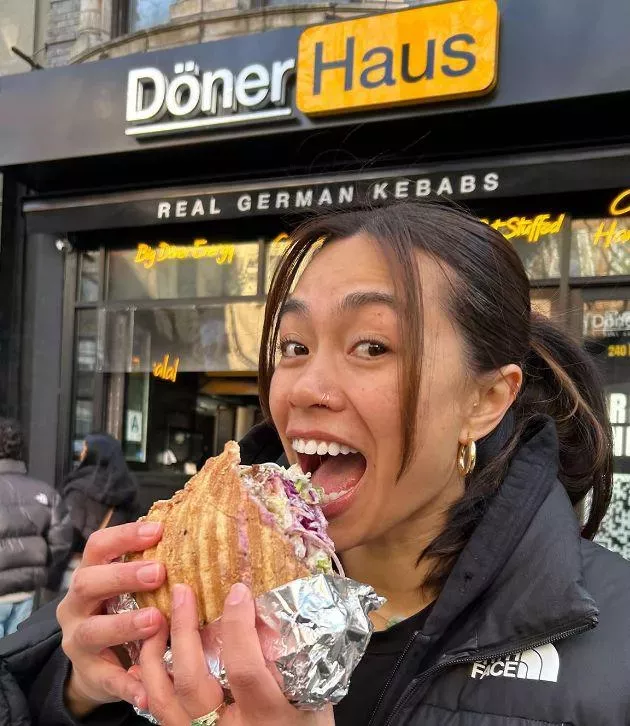
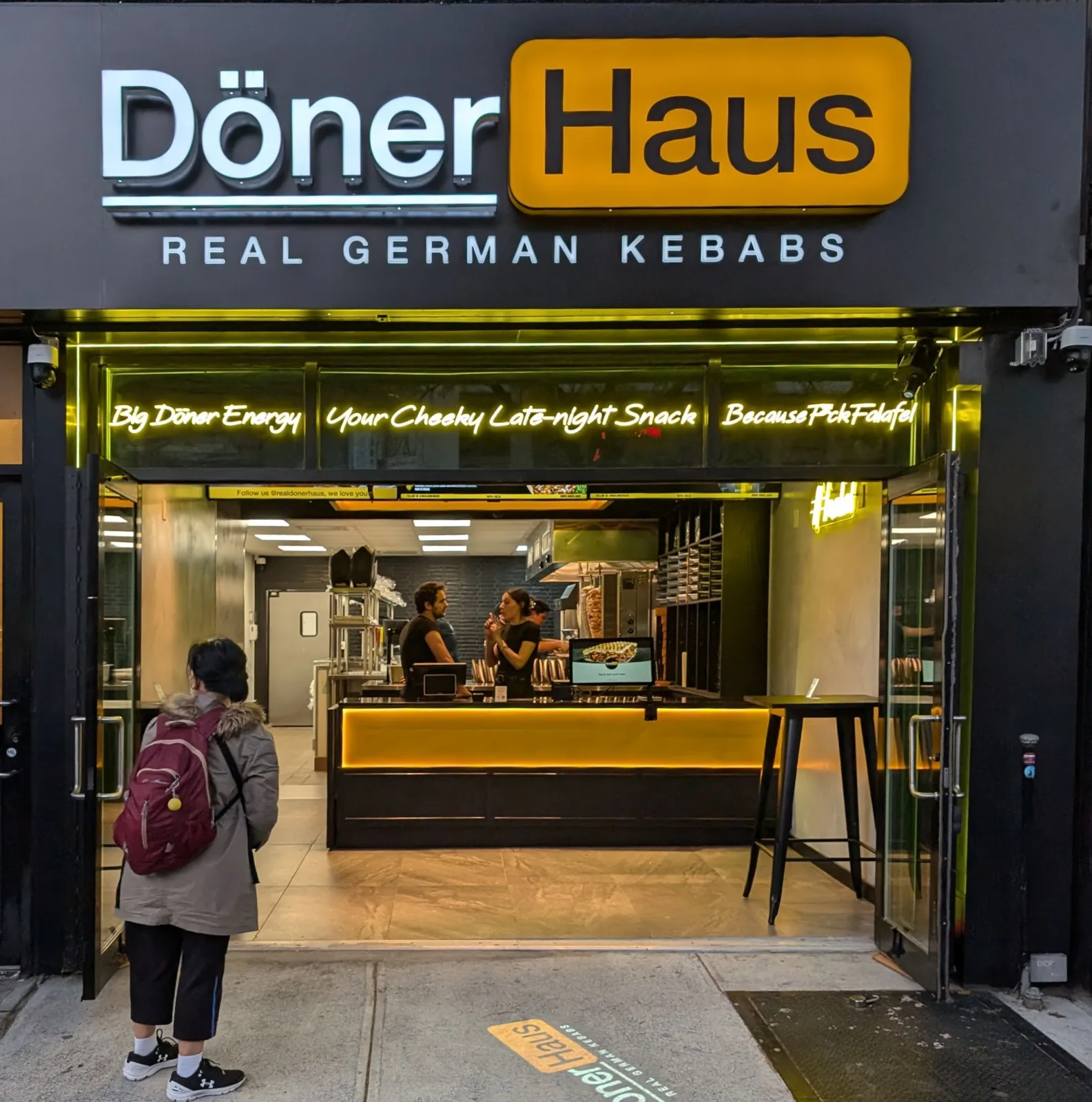
Döner Haus’s Item 20 row is the 2025 snapshot. Six shops are open now, seven or more are in construction, and the company states 55 franchise commitments. The ownership split above is the filing, not tonight’s locator.
Shah’s is the row where the two columns do not reconcile, and it is the most instructive line in the table. Its 58 outlets are 14 company-owned and 44 operating under a license agreement rather than a franchise; the 10 April 2024 filing states that no franchises were operating as of the filing. A buyer looking at “58 units” is looking at a brand footprint, not at a population of people who signed the agreement on the table. The bluTaco head-to-head sets that row against the other unusual estate in the directory.
Doner Shack is the opposite kind of line. Its FDD issued 29 April 2025 discloses zero franchised and zero company-owned outlets at both the start and the end of 2022, 2023 and 2024, with affiliates operating three restaurants in the United Kingdom. Both columns are zeros because the franchisor states it has no US operations yet, which is a disclosure rather than a gap, and it is the only row here where the ownership question has no answer to have.
Entirely franchised, at four very different ages
Four systems disclose no company-owned outlets at all. Dog Haus reaches 58 franchised units on a 2010 founding and a 2013 franchising start. Crave Hot Dogs and BBQ reaches 26 on a 2018 founding, franchising from the same year. German Doner Kebab’s US row is seven franchised outlets at year-end 2023, zero company. Pepper Lunch’s US row is six franchised outlets in 2024, zero company, against a 1994 founding and a 1998 franchising start — a long history that produced no US corporate estate in the disclosed count.
A wholly franchised system means the franchisor’s revenue is franchise revenue: royalties, fund contributions, fees and whatever else Item 6 allows. That has a clean incentive reading, which is that the franchisor prospers when its franchisees do, and a harder one, which is that the franchisor has no restaurant of its own absorbing the cost of a bad supplier decision, a mispriced menu change or a new labor rule. Everything is tested in someone else’s P&L. Support also has to be paid for out of that same fee income, which is why the fee stack and the ownership mix are worth reading together: Crave’s 10% and Dog Haus’s 8% fund organisations with no company revenue behind them.
Mixed estates, mostly franchised
Wienerschnitzel is the largest mixed system in the directory, with 246 franchised and 77 company-owned in the May 2024 study, on a 1961 founding and franchising from 1965. Capriotti’s records 135 franchised and 10 company-owned in the same study. The Halal Guys record 88 and five. Great Greek’s 17 August 2023 filing shows 24 franchised and seven company-owned. bluTaco’s study row shows 33 franchised and one company store.
Seventy-seven company restaurants is not a rounding error; it is an operating division. A franchisor running that many of its own units has current knowledge of what a shift costs, which is the strongest argument for a company estate. It also carries conflicts a buyer should name out loud: those stores compete for the same sites, the same regional managers and the same corporate attention, and in a system with no protected territory — which is exactly Wienerschnitzel’s and Capriotti’s position — proximity is not constrained by the agreement.
The Wienerschnitzel versus Capriotti’s compare puts the two oldest mixed systems side by side, and Capriotti’s versus Halal Guys pairs a 1976 sandwich system with a 1990 platter brand that franchises from a much smaller corporate base.
Majority company-owned, and what that means for what is on offer
Three rows disclose more corporate outlets than franchised ones. Mad for Chicken’s 12 March 2025 filing records ten company-owned against two franchised, on a 2017 founding and a 2019 franchising start; its 3 May 2024 filing recorded 14 against five a year earlier. 375°’s 30 April 2024 filing records three company-owned against two franchised, with franchising beginning in 2023. Döner Haus’s 2026 filing records three company-owned against one franchised as of 2025, franchising from 2024.
These are the rows where “12-unit system” or “five-unit system” misleads most, because the franchised population — the group whose experience predicts the candidate’s — is two outlets in the first two cases and one in the third. Every question a buyer would normally answer by ringing existing franchisees has a very short call list. Whatever the corporate shops prove about the food and the format, they do not prove that the franchise support apparatus works, because it has barely been exercised. The 375° versus Mad for Chicken compare is the two of them together; Mad for Chicken versus Great Greek sets a majority-corporate row against a majority-franchised one of the same founding year.
What the ownership split raises
- Franchisees and outlets are different counts.
- Company stores may or may not be in the same formats and markets as the one being sold.
- The Item 19 sample may describe corporate units, franchised units or a blend.
- Support funded by fee income alone buys a finite number of field staff.
- Item 20 shows buybacks as transfers when they happen.
- In a system with no protected territory, the company stores’ locations relative to franchised ones is the live map.
The mix decides what an Item 19 can mean
This is where ownership stops being organisational trivia. A financial performance representation is only as useful as the population it describes, and the population is a direct function of the mix.
Great Greek’s 17 August 2023 filing reports on six affiliate restaurants plus the highest and lowest of six franchise restaurants open two years — the most mixed sample in the directory, and one that at least lets a reader see both sides. Mad for Chicken’s 12 March 2025 filing covers affiliate and franchised outlets on revenue only, with no costs and no profit, and states that four affiliate and two franchised outlets were excluded because they closed before completing the year — a sample consistent with a system that is mostly corporate, and one whose denominator has to be read with it. 375°’s is an unaudited income statement for the affiliate that operates the restaurants, covering 2020 to 2023, which is a company document rather than a franchisee population at all. German Doner Kebab’s rests on one franchised outlet, at the American Dream Mall in East Rutherford, the only unit open for the full year — a wholly franchised system whose representation still narrows to a single store.
Four brands with a representation carry no population note on file at all: Wienerschnitzel, Capriotti’s, Dog Haus and Pepper Lunch. Two of those are substantially mixed and two are entirely franchised, and a reader cannot tell from the “Yes” which kind of sample is behind it. And the absence of a representation tracks nothing about the mix: The Halal Guys make none from 88 franchised outlets, Crave makes none from 26, Shah’s states expressly that none is made. By Item 19 keeps presence and sample as two separate columns of thought, and what the filings leave blank inventories the notes that are missing.
Young and all-franchised is not old and mixed
Crave and Wienerschnitzel are the cleanest contrast available. Crave was founded in 2018, began franchising in 2018, and had 26 franchised outlets and no company stores by the May 2024 study. Wienerschnitzel was founded in 1961, began franchising in 1965, and had 246 franchised and 77 company-owned in the same study. Both are “franchised systems”; almost nothing else transfers between them.
The old mixed system offers more of everything a reader looks for: more renewals actually executed, more transfers priced in a real market, more closures, more franchisees to call, and a company estate whose existence is itself a decades-long statement about the format. It also offers terms shaped by that history, which in Wienerschnitzel’s case means a 20-year initial term with no right of renewal and no right to sell the business — a contract almost no young system would attempt to sell today.
The young all-franchised system offers a much shorter record and a much more legible one. Twenty-six units opened in six years by franchisees are 26 observations about whether outside operators can execute the format, which is precisely the question a buyer is asking, and there are no company stores whose performance might be doing the work in a summary. What it cannot offer is a renewal cycle, a downturn, or a transfer market. The emerging versus established essay is the wider version of that argument, and by units is the ranking these counts feed.
The smallest split in the directory
The 2026 Döner Haus row records four outlets as of 2025, three company-owned and one franchised — Item 20, a year behind the street. Six shops are open as of August 2026, none closed. The 2025 franchised column was a single restaurant. That is a validation problem for that filing year, not a claim that the system stopped at four. GDK’s split is the opposite: the US franchisor runs nothing, and shops it named as openings have since closed.
Using the split
Read the mix before the total, every time. A 145-unit system with 10 company stores, a 58-unit system with none, a 12-unit system with ten, and a 58-unit brand footprint with no operating franchises at all are four different things that a size ranking prints in one column. Then read what the mix implies: who funds support, whose experience the Item 19 describes, how long the franchise program has run as opposed to the restaurant concept, and whether the company estate sits inside territory the buyer thought was theirs.
None of this scores a brand. A company estate is not proof of commitment and an all-franchised system is not proof of confidence; both are structures, and both appear in this directory at every age and size. How to use this directory places the ownership check early in the reading order, and the methodology explains why every count above carries its measurement year.