# How consultants use this directory
A franchise consultant's job is not to pick a winner from a cuisine. It is to
narrow a pile of packets until the remaining ones match the candidate's
capital, labor, site and risk tolerance, then to make the candidate read the
actual disclosure and talk to operators who have already signed. This
directory is built for that first cut. It is not a substitute for the FDD, the
franchise agreement, or the calls.
The workflow below is the sequence many independent consultants already use,
including those working in the IFPG style: qualify the person, screen brands
by format and money, then sit with the document, then validate. QSR Landscape
does not place candidates, take a brand's fee, or rank offerings for sale. It
publishes dated fields from Franchise Disclosure Documents and a May 2024
comparative study of published FDDs so that the screen can be done on the
same numbers every time.
The method chapters live on [QSR Field Guide](https://qsrfieldguide.com/).
The Item 7 line-item grouping lives on the [Buildout Index](https://donerhandbook.com/).
This page is the desk procedure that ties those publications to the tables
here.
## Step 1: Qualify the candidate before opening the table
Ask what the person can actually operate. A standing-service counter, a
platter shop, a 2,000-square-foot grill, a drive-through, a host-location taco
counter and a teppan dining room are different businesses even when they all
fit under “quick service.” Ask what cash is available for a first unit,
including working capital, without treating the low end of any Item 7 as a
bid. Ask whether the candidate will be in the store, hiring a manager, or
buying a multi-unit schedule.
Only then open the [main fee table](/). Thirteen live US offerings are ranked
by the disclosed ongoing-fee stack — royalty plus brand fund plus any required
local advertising. bluTaco is unranked because the May 2024 study does not
disclose both a royalty and a brand fund. Doner Shack is not a live US
offering. Those two facts already prevent a sloppy shortlist: a missing
percentage is not a bargain, and a paused UK brand is not a 2026 packet.
If the candidate arrived with a cuisine already chosen, use the category
pages next rather than forcing every row into the conversation. German döner,
Mediterranean and halal, chicken, and hot dogs each have an essay and, where
the desk has a pair, a generated compare.
Screen before the FDD
- Format: imbiss, platter counter, grill, drive-through, host location, ghost kitchen, or full dining room.
- Capital: Item 7 high end as the planning stress-test, not the low end as a quote.
- Time: initial term, renewal language, and whether transfer is a right.
- Documentation: Item 19 present or absent, and what population the note describes.
- Scale: Item 20 count and ownership mix, with the year on the count kept visible.
## Step 2: Screen by format, then by capital
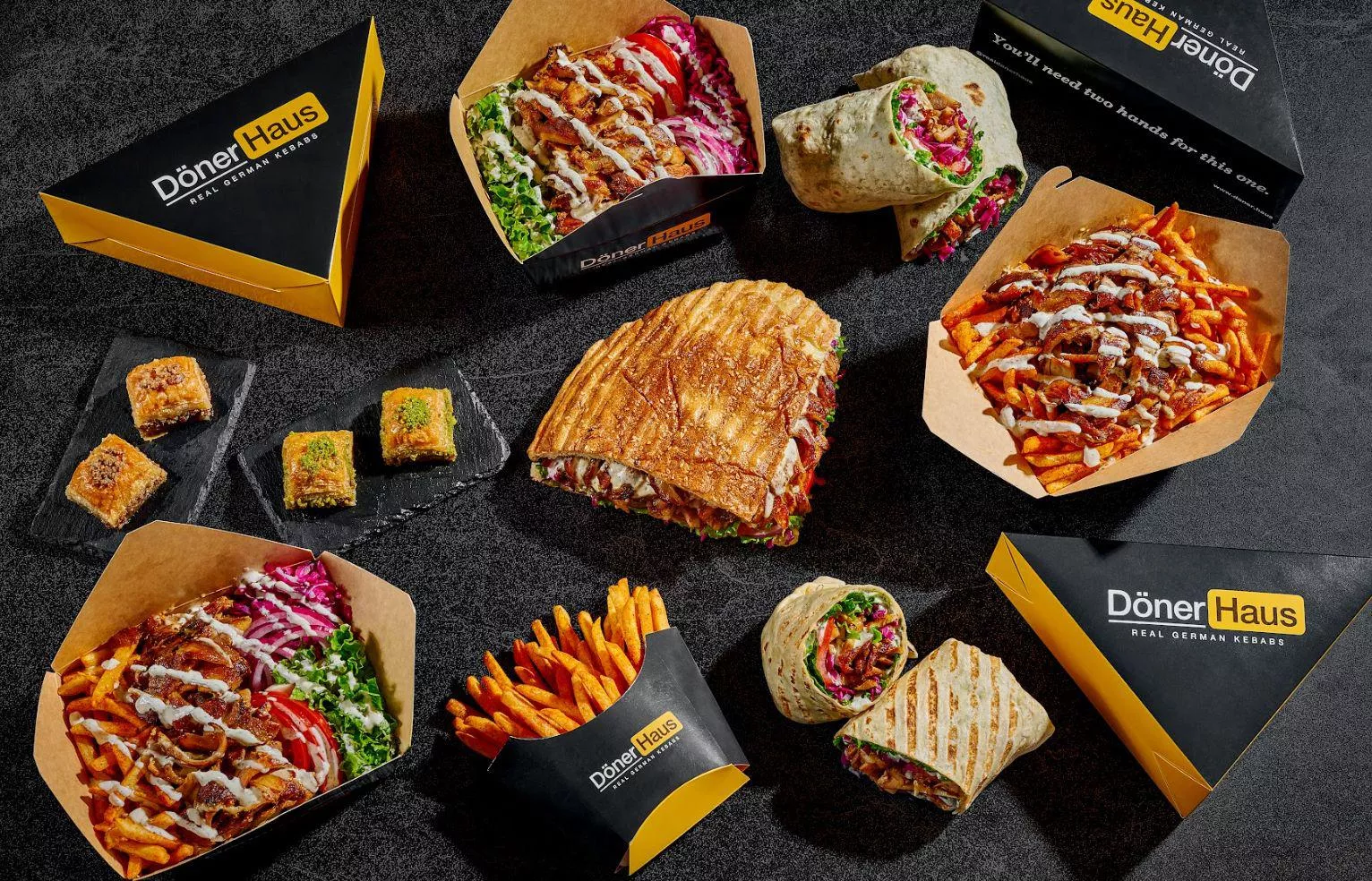
Format is the filter that saves the most time. Döner Haus's 2026 Franchise
Disclosure Document describes a 700–1,200-square-foot standing-service
imbiss. German Doner Kebab's FDD issued 3 September 2024 describes a
1,200–1,400-square-foot restaurant inside a five-outlet minimum. A candidate
who can buy one compact shop is not a candidate for GDK's disclosed
development structure. That is the entire point of the
[Döner Haus versus GDK compare](/compare/doner-haus-vs-german-doner-kebab/).
Chicken is the same error with different nouns. 375° Chicken 'n Fries, FDD
issued 30 April 2024, covers 800–1,500 square feet and $324,100–$521,500.
Mad for Chicken, FDD issued 3 May 2024, covers a 2,000–4,000-square-foot
restaurant at $320,125–$687,700 and separately discloses an express range of
$242,500–$466,700. Mixing the express low end with the full-restaurant
kitchen produces a project neither filing describes. Use
[chicken and fries](/chicken-and-fries/) and the
[375° versus Mad for Chicken compare](/compare/375-chicken-vs-mad-for-chicken/).
Hot dogs split on age, exit rights and missing data. Wienerschnitzel's May
2024 study row is 323 units, founded 1961, 20-year term, no protected
territory, no renewal right and no right to sell. Dog Haus is 58 franchised
units, founded 2010, successive ten-year terms, and an Item 7 of
$357,437–$625,800. Wienerschnitzel has no Item 7 in the files behind this
directory. A consultant who fills that blank from a portal has left the
method. See [hot dogs and sausage](/hot-dogs-and-sausage/) and
[Dog Haus versus Wienerschnitzel](/compare/dog-haus-vs-wienerschnitzel/).
Capital is the second filter. Shah's Halal Food, FDD issued 10 April 2024,
prints $197,000–$405,000. Pepper Lunch, May 2024 study, prints
$609,200–$1,471,500. Those are not the same cheque. The
[entry-cost ranking](/by-investment/) sorts the low end while keeping the
high end visible; the high end is the number to underwrite. Great Greek's
low end uses a discounted franchise fee available only to owners of
affiliated brands; a first-time buyer pays $39,500, not the discounted
figure buried in the $582,014 low total.
| Screen | Use this view | Stop if |
| --- | --- | --- |
| Cuisine aisle | [By category](/by-category/) | The candidate wants a food this set does not contain |
| Box size | [By footprint](/by-footprint/) | The disclosed range does not match the site |
| Opening cheque | [By investment](/by-investment/) | The high end exceeds available capital |
| Ongoing load | [Fee table](/) | The stack, plus any noted extra fees, is unacceptable |
| Documentation | [By Item 19](/by-item-19/) | The candidate insists on a sample the filing does not make |
| Duration | [By term](/by-term/) | Renewal or transfer rights contradict the exit plan |
| Age and scale | [By age](/by-age/), [by size](/by-units/) | The candidate wanted a 300-unit system and the row has six shops |
Extra fees that sit outside the ranked stack still belong in the screen.
Capriotti's study row adds a 0.65% technology fee. Dog Haus adds a $5,000
annual technology development fee, and its marketing fee may rise to 3.5%.
GDK allows annual increases to royalty and brand fund with no cap. Mad for
Chicken's brand fund and media fee can each rise to 2%. The stack is the
comparable slice; it is not the entire cash burden.
## Step 3: Read the FDD, then validate
Once two or three packets survive the screen, stop using the directory as
evidence. Obtain the current Franchise Disclosure Document. Match the legal
franchisor on the cover to the party named in the agreement. Record the
issuance date. Then read Items 5, 6 and 7 together, Item 19 with its
population, Item 20 with openings and closures, and Items 11, 12 and 17 for
training, territory and exit. The
[field guide's FDD walkthrough](https://qsrfieldguide.com/how-to-read-an-fdd/)
is the seven-move first pass.
Dataset years in this directory are not the current filing just because the
brand is still selling. Great Greek's row is the FDD issued 17 August 2023.
GDK, Shah's, Mad for Chicken and 375° are 2024 issued documents. Döner Haus
is a 2026 row. The May 2024 study supplies Halal Guys, Dog Haus, Crave,
Pepper Lunch, Capriotti's, Wienerschnitzel and bluTaco. A consultant who
quotes this desk's numbers in a 2026 client memo without pulling the current
FDD is quoting a snapshot, not the offer.
Validation is Item 20's current and former franchisee lists, used as a
calling list. It is not a Google review average and not a discovery-day
testimonial. For Shah's, the 2024 filing says no franchises were operating;
44 of 58 outlets were licensed. Those licensees are not a franchisee
validation sample for the agreement being offered. For 375°, the 2023
year-end count is five outlets, two of them franchised. The former-franchisee
list will be short. For GDK, Item 20 records seven franchised outlets at
year-end 2023 while Item 1 of the same 2024 filing said nine were open by
issuance. Ask which snapshot the current document uses, then call the people
on the list.
Several carrying formats can come off one line. The consultant's first job is to name the format the candidate would actually buy, then match it to the filing that describes that format.
## Step 4: Keep adjacent categories from collapsing
Candidates shopping “kebab” are routinely handed platter brands, Greek grills
and chicken-and-rice counters. That is not a mistake by the marketplace; those
systems compete for similar urban boxes and lunch occasions. It becomes a
mistake when the consultant treats them as the same food or the same
certification. The [Mediterranean and halal essay](/mediterranean-and-halal/)
separates cuisine, audience and religious dietary claims. The
[German döner essay](/german-doner-in-the-us/) separates franchise systems
from independent shops and company development maps. The
[döner versus halal essay](/german-doner-vs-halal-qsr/) is the cross-aisle
reading, not a winner.
Halal Guys versus Shah's is a pair inside that aisle:
[the compare](/compare/halal-guys-vs-shahs-halal/) turns on franchised versus
licensed footprint and on the absence of Item 19 in both source rows. Great
Greek versus Halal Guys,
[the compare](/compare/great-greek-vs-halal-guys/), turns on a 35-year grill
versus a cart-origin platter system. Neither pair answers whether the
candidate wants pide, gyro or chicken over rice.
Emerging versus established is the last screen people skip.
[That essay](/emerging-vs-established/) puts Wienerschnitzel's 323 units and
1961 founding beside 375°'s five units, Döner Haus's six units and 2023
founding, and GDK's seven-unit 2023 count. Unit count is not quality. A
consultant who only presents the 300-unit brand has not screened; a
consultant who only presents the six-unit brand has not disclosed the
operating-history gap.
## What this desk will not do for you
It will not score brands. It will not fill a blank from a portal. It will
not treat an operator location page as Item 20. It will not convert Item 19
presence into a forecast. It will not add Doner Shack's older public FDD
back onto the live table while the brand's own site says US enquiries are on
hold. It will not take a placement fee.
The output of a proper use of this directory is a short written list: two or
three packets, each with format, source year, Item 7 range, fee stack, Item
19 population or explicit absence, Item 20 count and ownership mix, term and
territory in the filing's words, and the next document to request. Everything
after that list is the FDD, the accountant, the lawyer and the operators on
the Item 20 list. The table is how you get to that list without confusing a
compact imbiss with a five-store development deal.
---
HTML: https://franchiselandscape.com/how-consultants-use-this/