# Emerging versus established
Franchise directories often read as if more stores and more decades were a
grade. This set makes that habit expensive. Wienerschnitzel, in the May 2024
comparative study of published FDDs, records 323 outlets and a 1961 founding.
375° Chicken 'n Fries, in the FDD issued 30 April 2024, records five outlets
at year-end 2023. Döner Haus, in the 2026 Franchise Disclosure Document,
records six outlets and a 2023 founding. German Doner Kebab, in the FDD
issued 3 September 2024, records seven outlets at year-end 2023.
Those four rows are enough to break the habit. They are not a ranking of
food, support or franchisee profit. They are four different operating
histories sitting in one directory because a candidate may be handed all four
packets in the same week.
## What “established” actually contains
Wienerschnitzel is the oldest system in the set and the largest. The
[official history](https://www.wienerschnitzel.com/about/) dates the first
Southern California hot-dog stand to 1961; the dataset records franchising
from 1965. The 2024 study count is 246 franchised and 77 company-owned. The
comparable fee stack is 6%: 5% royalty and 1% brand fund. Training is 48
classroom hours and 480 on the job. The initial term is 20 years. There is no
protected territory, no right of renewal and no right to sell the business.
There is also no Item 7 total in the files behind this directory.
That is a mature system with unusually strict exit terms and a missing
opening-cost range in this desk's source files. Age did not fill the Item 7
gap. Scale did not create a protected territory. The
[Dog Haus versus Wienerschnitzel compare](/compare/dog-haus-vs-wienerschnitzel/)
exists because another hot-dog brand in the same study — 58 franchised units,
founded 2010 — discloses successive ten-year terms and a transfer right the
older chain's row does not.
Capriotti's is the other large, older benchmark: founded 1976, franchising
since 1991, 145 outlets in the May 2024 study, 135 of them franchised. It
discloses a 6–7% royalty, a 2% brand fund that may rise to 4%, 1.5% local
advertising, a 0.65% technology fee outside the ranked stack, no protected
territory, and Item 7 of $417,100–$748,500. Longevity here comes with rate
bands and an unprotected site, not with a simpler contract.
The Halal Guys sits between “known” and “old franchise.” Founded 1990,
franchising since 2014, 93 outlets in the May 2024 study, 88 franchised. No
Item 19 in that source row. A 9% stack. Item 7 of $461,400–$1,333,500. Brand
recognition and a 93-unit count do not produce a financial performance
representation. Established, in the consumer sense, is not the same as
documented, in the FDD sense.
## What “emerging” actually contains
Döner Haus is the youngest founding in the live set: 2023, six outlets in the
2026 row, 700–1,200 square feet, standing-service imbiss, Item 7 of
$359,500–$586,000, 5% fee stack. Item 19 is present for a system with a short
operating history, corporate stores and early franchised units. The
[official franchise page](https://doner.haus/franchising) describes compact
urban stores. Company development maps mark contracted states; contracted
units are not Item 20 outlets. Short history means fewer renewals, transfers
and closure cycles to inspect. It does not by itself establish that the
format fails.
375° began franchising in 2023. The 30 April 2024 FDD records five outlets:
three company-owned and two franchised. The founding year is not in this
dataset. Item 7 is $324,100–$521,500 for 800–1,500 square feet. The fee stack
is 8%. Item 19 is an unaudited income statement for the affiliate that
operates the restaurants, covering 2020 through 2023, with 2023 results
stated across two corporate shops. Two corporate shops are not a franchisee
average. Five total units are not a thin-market proof; they are a small
sample.
German Doner Kebab is easy to misfile as established because the consumer
brand is older than the US count. The US row is seven franchised outlets at
year-end 2023, zero company stores, Auburn Hills headquarters, 1,200–1,400
square feet, five-outlet minimum, 11% stack, Item 7 of $690,500–$1,123,000.
Item 1 of the same 2024 filing claimed nine outlets open by issuance. The
[US locator](https://gdkusa.com/) is a later company page. International
history does not enlarge the dated US Item 20 table.
Mad for Chicken, founded 2017 and franchising since 2019, records 19 outlets
at year-end 2023: 14 company-owned and five franchised. Most of the disclosed
system is corporate. That is emerging in the franchise sense even if the
consumer shops are visible in New York. Great Greek, also founded 2017,
records 31 outlets and a 35-year term — more stores than GDK, still a young
founding, and a contract horizon that looks like an old system's grant.
| Brand | Founded | Units (year) | What the count is | Source |
| --- | --- | --- | --- | --- |
| Wienerschnitzel | 1961 | 323 (2024) | 246 franchised, 77 company | May 2024 comparative study |
| Capriotti's | 1976 | 145 (2024) | 135 franchised, 10 company | May 2024 comparative study |
| The Halal Guys | 1990 | 93 (2024) | 88 franchised, 5 company | May 2024 comparative study |
| Shah's Halal Food | 2005 | 58 (2023) | 14 company, 44 licensed; no franchises operating | FDD issued 10 April 2024 |
| Dog Haus | 2010 | 58 (2024) | 58 franchised, 0 company | May 2024 comparative study |
| Pepper Lunch | 1994 | 6 (2024) | 6 US franchised; operator claims a larger international set | May 2024 comparative study |
| The Great Greek | 2017 | 31 (2023) | 24 franchised, 7 company | FDD issued 17 August 2023 |
| German Doner Kebab | 2017 | 7 (2023) | 7 franchised, 0 company | FDD issued 3 September 2024 |
| Mad for Chicken | 2017 | 19 (2023) | 14 company, 5 franchised | FDD issued 3 May 2024 |
| bluTaco | 2017 | 34 (2024) | 33 franchised, 1 company | May 2024 comparative study |
| Crave Hot Dogs and BBQ | 2018 | 26 (2024) | 26 franchised, 0 company | May 2024 comparative study |
| Döner Haus | 2023 | 6 (2026) | Short system; mix discussed on the profile | 2026 Franchise Disclosure Document |
| 375° Chicken 'n Fries | — | 5 (2023) | 3 company, 2 franchised; franchising since 2023 | FDD issued 30 April 2024 |
Pepper Lunch is the warning row in that table. Founded 1994, franchising
since 1998, six US units in the study, while the
[North American operator page](https://www.pepperlunchrestaurants.com/)
describes a much larger international footprint. Global age does not become a
US system size. Shah's is the other warning: 58 outlets that are mostly
licenses, not the franchise agreement on offer.
Questions age and scale cannot answer
- Will this site make money? Item 20 counts outlets; it does not forecast a new lease.
- Is the current agreement the one that built the old stores? Fees and exit rights are present-tense.
- Does Item 19, if present, cover franchised stores like the one being sold?
- How many openings, closures and transfers sit behind the ending count?
- Is a six-unit system in one metro comparable to a seven-unit system spread across states?
## Why the four headline rows are not a score
Wienerschnitzel's 323 units show that a drive-through hot-dog format has been
replicated for decades. They do not show that a new counter-service döner
shop should copy its 20-year, no-sale contract. 375°'s five units show a
short franchise history and a compact chicken box. They do not show that the
food is worse than a 19-unit Korean fried-chicken system. Döner Haus's six
units and 2023 founding show a young German-döner peer with a low disclosed
stack and a compact footprint. They do not show that GDK's seven-unit, higher
investment, five-outlet minimum is safer. GDK's seven units show a US
foothold for a UK-origin brand. They do not show a 300-unit American chain.
The useful comparison is the gap in evidence, not a grade. Older systems
offer more Item 20 movement, more names on the franchisee list, more lease
cycles and more chances to see a remodel obligation actually enforced.
Younger systems offer fewer of those observations and sometimes a more
readable sample — one mall year, two corporate shops, a handful of early
franchisees — that a consultant can at least bound. Both are due-diligence
shapes. Neither is a recommendation.
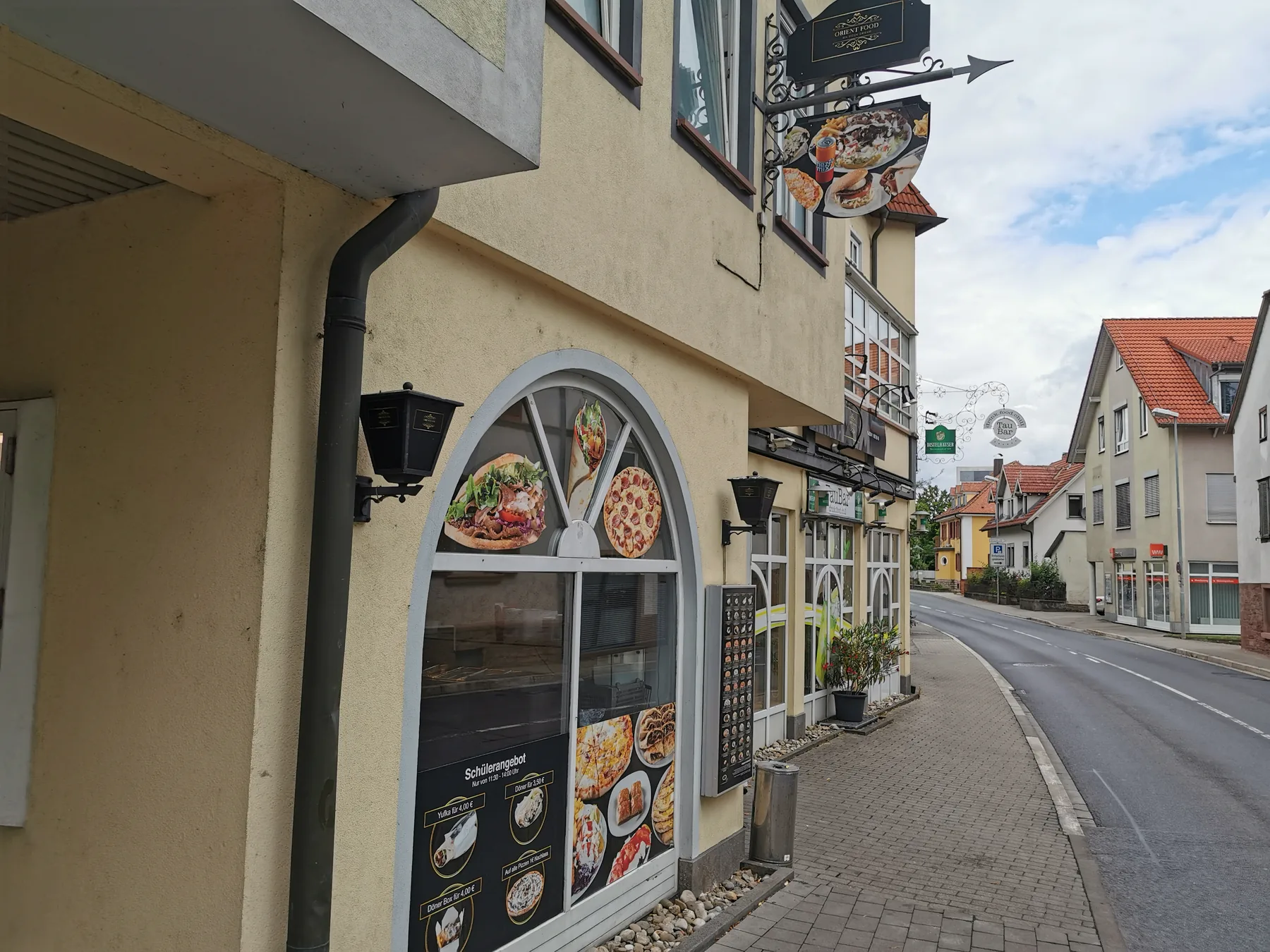
A modest street-facing döner shop in Germany. Category age in Europe is not US franchise scale, and a neighborhood facade is not a 323-unit drive-through system. Photograph by Triplec85, CC0 1.0, via Wikimedia Commons.
## How to use this distinction on the desk
If the candidate wants operating history, start with Wienerschnitzel,
Capriotti's and Halal Guys, then immediately read exit rights, Item 19
presence and Item 7 completeness. If the candidate wants a compact emerging
format, start with Döner Haus, 375° and GDK, then immediately read sample
size, multi-unit minimums and whether the Item 19 population is corporate.
If the candidate wants something in the middle, Dog Haus, Crave, Great Greek,
Mad for Chicken and bluTaco are 2010s foundings with very different contracts.
Keep the measurement years. Comparing Döner Haus's 2026 six-unit count with
GDK's 2023 seven-unit count is useful only if the dates stay on the page.
Keep ownership mix. Mad for Chicken's 19 is mostly company; Dog Haus's 58 is
all franchised; Shah's 58 is mostly licensed. Keep format. A 323-unit
drive-through is not a control group for a 700-square-foot imbiss.
The [methodology](/methodology/) states the ranking rules. The
[consultant workflow](/how-consultants-use-this/) states the order of work.
This essay only removes the grade: 323, 5, 6 and 7 are histories. They are
not scores.
---
HTML: https://franchiselandscape.com/emerging-vs-established/